The Secret of the Light of the Torah: The Path to the Revelation of the Shechinah (Divine Presence)
Lesson No. 110 | Cassette 110, Wednesday, Parashas Va'eschanan, 10 Menachem Av 5757 - A lesson at the Third Wall at the opening of the Bein HaZmanim (intercession) yeshiva for the young men of the Breslov Yeshiva Nechamas Tzion Shuvu Banim (continued in No. 111)
The sun and electric lighting are not the true light of the world—only the holy Torah can illuminate our eyes. A special article based on the teachings of the Ramchal and Rebbe Nachman of Breslov, explaining how Torah study is the sole key that allows the Shechinah (Divine Presence) to be revealed to us and elevate us from the darkness.
Due to our many sins, the true grace of the Jewish people has fallen, and only the holy Torah can raise it back up. The Ramchal explains this beautifully in his book "Tikkunim Chadashim," which was written similarly to the "Tikkunei HaZohar" of Rashbi zy"a, stemming from supernal revelations. In the fiftieth Tikkun, the words of the Ramchal shed wondrous light on the teachings of our holy Rebbe Nachman and reveal tremendous secrets to us.
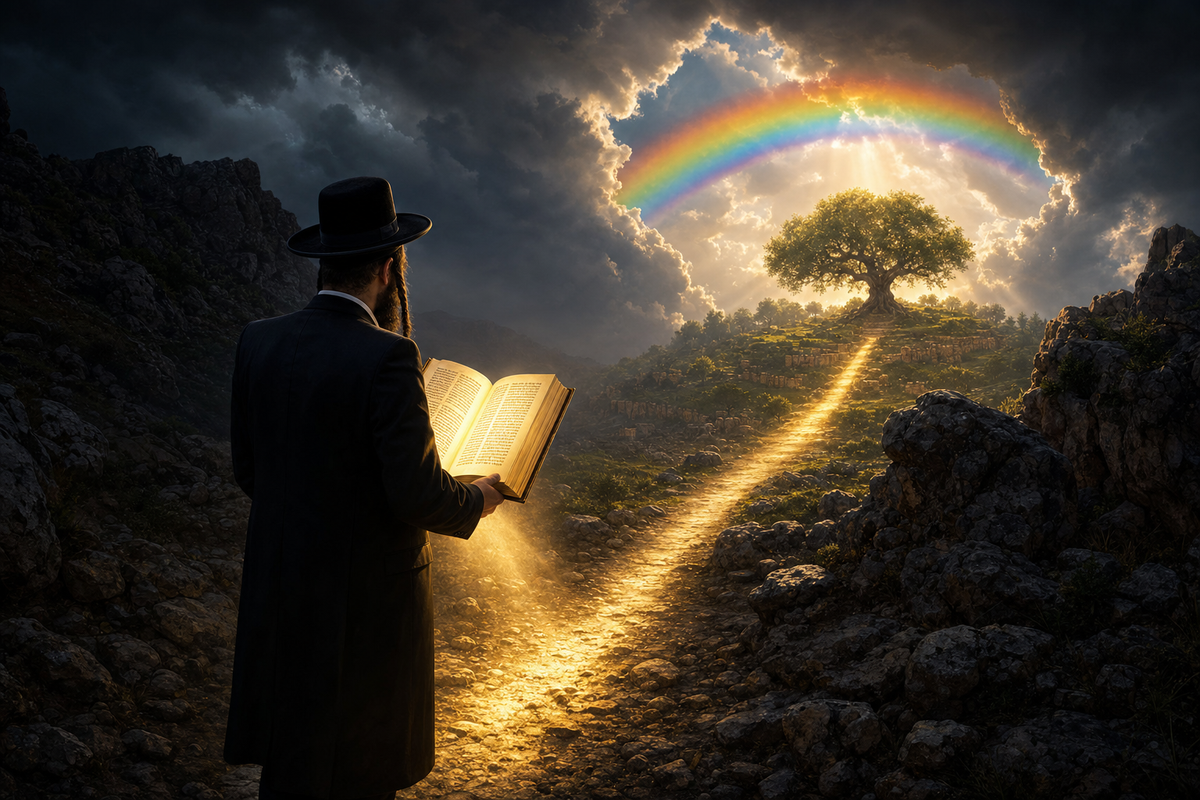
The Ramchal discusses the verse, "And the rainbow shall be seen in the cloud." The rainbow symbolizes the holy Shechinah (Divine Presence). But to whom is the Shechinah revealed? A person wants to see the Shechinah, but it is only revealed to someone whose eyes have been opened to see by the light of the Torah. Only when a person studies Torah is he capable of seeing the Shechinah standing before him, as it is stated:
"For a mitzvah is a lamp, and the Torah is light."
The Torah is what creates light for a person. After all, "The whole earth is full of His glory"—the Shechinah (Divine Presence) is everywhere, so why do we not see it? Because we are immersed in darkness. The sun or neon lighting are not considered true light; the only true light is the light of the Torah.
Emerging from the Darkness
When a person is immersed in sorrow, he sees nothing; everything is dark for him. A person sitting on the ground in mourning and crying sees no light. Baruch Hashem, among us everyone lives until a hundred and twenty, but spiritually we are in darkness; we do not see the Shechinah (Divine Presence). As we said in the Kinos (lamentations) of Tisha B'Av: "He has placed me in darkness like the eternally dead." One who does not study Torah has no light whatsoever.
Regarding such a person, Rebbe Nachman brings (Likutei Moharan, Torah 9) the verse:
"He who turns away his ear from hearing Torah, even his prayer is an abomination."
Why is the spiritual service of one who does not study Torah considered an abomination (to'evah)? The Gemara in Tractate Nedarim explains that the word "to'evah" is composed of the words "to'eh atah bah" (you wander astray in it). When a person does not study Torah, his spiritual service wanders astray on the path; it gets lost and does not know how to ascend.
A World Full of Salvations
The spiritual service of a Jew is an entire world, a complete sanctuary, and a tremendous reality. It has the power to bring the Geulah (Redemption) and to effect immense salvations for the Jewish people and for every individual in particular. We pray, "You graciously endow man with knowledge," in order to receive a new mind, a new intellect. But for these things to have their effect, they must ascend to their root.
When the light of the Torah is lacking, a person wanders from place to place. He does not see how to ascend upward and enter the innermost chambers. Even the angels cannot elevate him. A young man might not feel this; he sees a rosy world and thinks everything is his, but in truth, to pierce the heavens and effect salvations, one needs guidance. Without Torah, a person is in the aspect of "wandering astray in it"—he walks and wanders, unable to find the opening to ascend.
The Path to the Tree of Life
In contrast, when a person is connected to the light of the Torah, the Torah illuminates the path for him. In the merit of the light of the Torah, he proceeds and ascends directly to his supernal root, enacting all the tikkunim (rectifications) there.
Regarding such a person it is said, "And the rainbow shall be seen in the cloud"—the Shechinah (Divine Presence) is revealed to him. He cleaves to it and walks in a straight line. He follows in the footsteps of the Torah, and this is the straight path, the secret of the Tree of Life which is entirely good without any evil. Whoever walks on this path, the Torah purifies him from the sin of the Tree of Knowledge, and he merits the true and complete tikkun (rectification).
In light of this, we must understand that there is no such thing as "it is hard to study Torah." The difficulty stems only from a lack of knowledge, a lack of proper perspective, and a lack of emunah (faith) in the greatness of the Torah. It is not truly difficult for anyone to learn. After all, a person has many free hours in the day, and sometimes he does not know what to do with them, wandering and straying here and there.
The advice is simple: Pick up a book! Take "Likutei Halachos," take a Chumash, take an elucidated Midrash. If it is hard for you to study Gemara, read the Midrashim on the weekly Torah portion, read stories of tzaddikim. The main thing is to bring the light of the Torah into your life, because only through it can we illuminate our path and merit the revelation of the Shechinah (Divine Presence).
Part 1 of 2 — Lesson No. 110
All parts: Part 1 (current) | Part 2
Subscribe to Our Newsletter
Receive Torah articles and inspiration directly in your inbox