The Secret of the Schach and the Four Species: Drawing Down the Lights of the Tribes Through Joy

Lesson No. 157 | Wednesday, the 2nd day of Chol HaMoed Sukkos, the eve of 18 Tishrei 5759, the yahrtzeit (anniversary of passing) of our holy Rebbe Nachman - at the Yeshiva
According to the holy Arizal, the schach (Sukkah roofing) and the Four Species correspond to the Sefiros (Divine emanations), the Forefathers, and the Twelve Tribes. This article explains how all of these illuminate us during the festival of Sukkos, and why the only way to merit these tremendous spiritual influences is specifically through song, melody, and dance with complete self-nullification before Hashem, as the Rambam rules.
The holy Arizal explains the tremendous secret of the schach. The schach encompasses all the upper Sefiros, corresponding to the Sefirah of Tiferes (Beauty/Harmony) of Ima (the Divine Mother principle). It binds together the Sefiros of Kesser (Crown), Chochmah (Wisdom), Binah (Understanding), Daas (Knowledge), Chesed (Loving-kindness), Gevurah (Severity), and up to the first third of Tiferes.
These seven Sefiros, which shine through the schach, correspond to the six sons of Leah: Reuven, Shimon, Levi, Yehudah, Yissachar, and Zevulun, together with the seventh Sefirah, Tiferes, which corresponds to Dinah.
"When we sit under the schach, we are sitting beneath the six sons of Leah together with Dinah, who are comprised of a hundred lights, and all these lights and tribes pass through the schach and illuminate us."
The Secret of the Four Species: Yosef, Binyamin, and the Sons of the Handmaids
After we take shelter in the shadow of the holy schach, we take the lulav and the esrog. The lulav corresponds to the Sefirah of Yesod (Foundation), and it draws down abundance from Atika Kadisha (the Ancient Holy One, the highest level of Divine will). The lulav is the soul of Yosef the tzaddik, which resembles the spine, connecting the upper and lower worlds—the secret of "all that is in heaven and on earth." Yosef ascends all the way to Atika Kadisha, and below he unites with Binyamin, who is the secret of the esrog.
The aravos (willow branches), the holy Arizal explains, correspond to the letter Hei of the holy Name of Hashem. When we take two aravos, they hint at the letter Hei in its fully spelled-out form (Hei and another Hei), creating four letters of Hei for us.
These four letters hint at the two sons of Bilhah (Dan and Naftali) and the two sons of Zilpah (Gad and Asher). Thus, together with the sons of Leah in the schach, and Yosef and Binyamin in the lulav and esrog, all twelve tribes shine upon us.
The Souls of the Holy Forefathers in the Hadasim
Now we are left with the three hadasim (myrtle branches). The holy Arizal reveals that the souls of the three Forefathers—Avraham, Yitzchak, and Yaakov—are imbued within the three hadasim.
The three-leaved hadasim correspond to the Sefiros of Chesed, Gevurah, and Tiferes. Thus, we merit that the three Forefathers also hover and shelter us through the hadasim, while we sit beneath the holy schach.
The Power of Songs and Melodies
How do we merit all these tremendous lights? The Rebbe of Lanchut explains that all of this comes in the merit of songs and melodies. The abundance descends in the merit of our mother Leah, who took up the mantle of gratitude, whose entire essence was only song and thanksgiving to Hashem, in the secret of the verse:
"This time I will thank Hashem" (Bereishis 29:35).
From here is drawn the soul of Mashiach ben David, who is entirely gratitude to Hashem. "All the spiritual influences and all of a person's successes throughout the entire year come in the merit of the songs and melodies that they prolong until their soul is completely poured out."
True Greatness and Honor
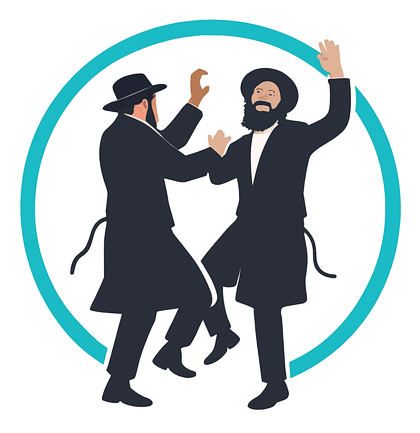
The holy Rambam rules that a person who stands in a place where everyone is singing and dancing, and refrains from doing so, is considered a sinner and a fool. King Shlomo warned about this in the Book of Mishlei (Proverbs):
"Do not glorify yourself before the King" (Mishlei 25:6).
Do not be overly clever and do not guard your imagined honor. When everyone is playing music and dancing—you too must sing and dance! One who tries to be too smart only brings troubles upon themselves and upon future generations, because "through every song and melody, the harsh judgments are sweetened and removed from the entire Jewish people."
When a person humbles himself in dance and feels a lessening of his own honor, he must know that this is his true greatness. Thus writes the Rambam: "And anyone who humbles himself and makes light of his body in these situations, he is the truly great and honored one who serves out of love and loves Hashem."
This is how King David acted; when he was mocked for his dancing, he replied:
"I will make myself even more lightly esteemed than this, and I will be humble in my own eyes" (Samuel II 6:22).
King David felt that all of his dancing and leaping was still not enough, and he yearned to dance even more. Because there is no true greatness and honor in this world, says the Rambam, other than to rejoice before Hashem, to leap and dance with all one's might, and to bring Him nachas ruach (spiritual satisfaction).
Lesson No. 157
Subscribe to Our Newsletter
Receive Torah articles and inspiration directly in your inbox