The Secret of the Shoes: The Sale of Yosef and the Rectification of the World
The Daily Chizuk from the Gaon and Tzaddik, Rabbi Eliezer Berland shlit"a
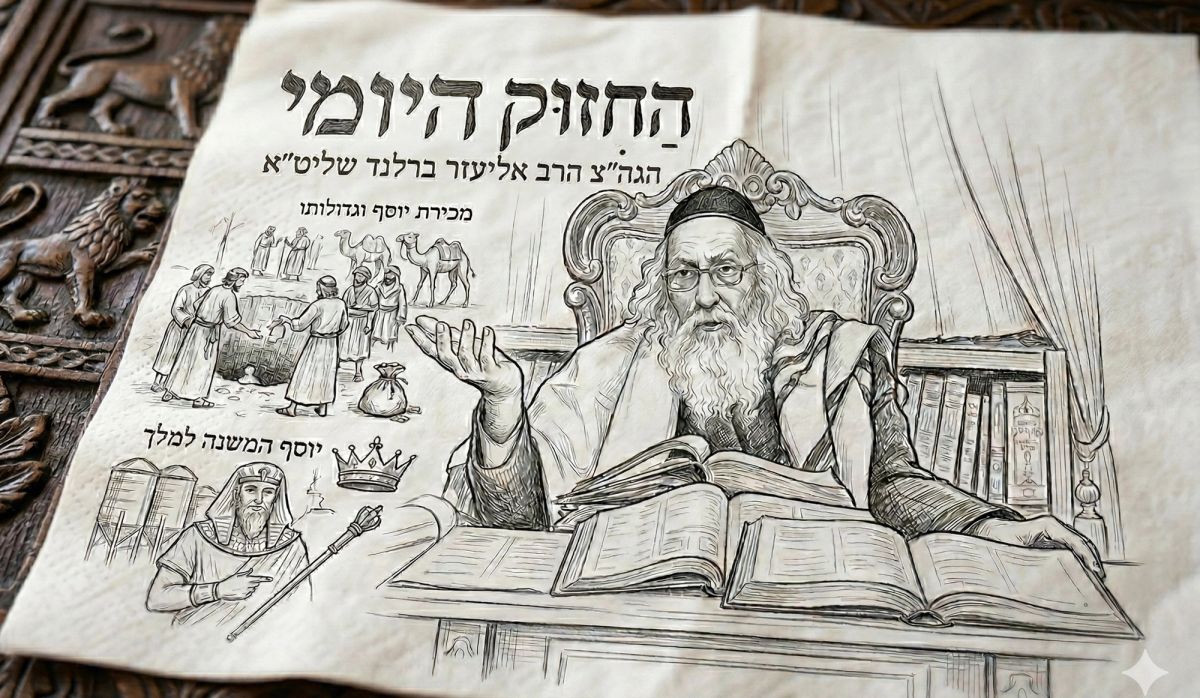
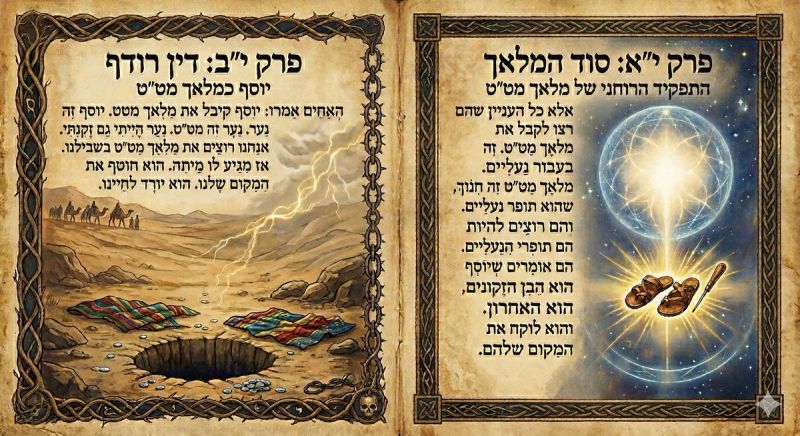
The chizuk (spiritual encouragement) presented before us focuses on the portion of the sale of Yosef (Joseph) from a unique perspective, combining the revealed and hidden dimensions of the Torah. The Rav, Rabbi Eliezer Berland shlit"a (may he live long and good days), unfolds a broad canvas that begins with Halachic (Jewish legal) questions regarding the motives of the tribes and reaches the very roots of faith in the creation of the world. Through the clarification of the act of the sale, we are exposed to the constant struggle for the tikkun (rectification) of reality and the unique power of the Tzaddik to transform dispute and concealment into a great light of faith.Chapter 1: The Price of the SaleThe Sale of Yosef: The Real Price and the Wealth of the Sons of YaakovWhat is the meaning of selling Yosef for "shoes"? Would they sell their brother for shoes? They had a hundred sheep. "And the man increased exceedingly" (Genesis 30:43). A hundred thousand sheep, a hundred thousand goats. The sons of Yaakov (Jacob) had endless wealth. They took all the property and livestock from Shechem. They could have sold one sheep and bought a hundred pairs of shoes. Instead of shoes, they sell their brother? And even the Shechinah (Divine Presence) agrees with them.Chapter 2: The Missing CountThe Tenth Number and the Hidden Status of YosefThey were nine and needed ten (Rashi on Genesis 37:33). To subdue Yosef, ten are required. They were nine. Binyamin (Benjamin) was in captivity, Reuven (Reuben) was in captivity, and Shimon (Simeon) was in captivity. They didn't know where Yosef was; they were searching for him. They thought he was some wretched slave. They didn't think he was a king. They came ready to kill or be killed.Chapter 3: Theft and Lost PropertyThe Accusation of Yosef Regarding Theft and the Logic of the BrothersHe said to them: "Are you stealing a goblet? Have you no shame, thieves!" We returned a million dollars to you, we returned it. For there is a dispute whether stealing from a non-Jew is permitted. Yosef said to the brothers: "You apparently think that stealing from a non-Jew is permitted. That is why you stole the goblet." So they answer him: "If stealing from a non-Jew is permitted, then a lost object is certainly permitted. This is a kal v'chomer (a fortiori argument). If a person thinks stealing from a non-Jew is permitted, then his lost object is certainly permitted to keep. But if you say a lost object is forbidden, it is forbidden to take. Then it is a kal v'chomer that it is forbidden to steal. Even a lost object, which is generally permitted—everyone agrees it's permitted—we were stringent upon ourselves and returned the lost object. So certainly we would not steal."Chapter 4: The Master of DreamsYosef's Dreams and the Erroneous InterpretationYaakov wanted to say that Yosef was not born from the sun. When a person says, "I dreamed the sun bowed down to me," should he be killed? The brothers said: "Let us kill him. He says the sun will bow to him." Tell him, these are idle words. Tell him, "You are dreaming dreams." "Behold, this master of dreams comes" (Genesis 37:19). Tell him, it never happened and was never created. What, just because a person dreamed the sun bowed to him, he must be killed?Chapter 5: The Secret of the AngelThe Spiritual Role of the Angel MatatRather, the whole matter was that they wanted to receive the light of the Angel Matat (Metatron). This is called "for the sake of shoes." The Angel Matat is Chanoch (Enoch), who is a cobbler (sews shoes). And they want to be the ones who sew the shoes. They say that Yosef is the youngest son, he is the last. And he is taking their place.Chapter 6: The Law of the PursuerYosef as the Angel MatatThe brothers said: "Yosef received the light of the Angel Matat." Yosef is a "na'ar" (youth). A "na'ar" is Matat. "I was a youth (na'ar), and I have also grown old." We want the Angel Matat for ourselves. Therefore, he deserves death. He is snatching our place. He is making our lives miserable.Chapter 7: Sefer YetzirahThe Creation of a Calf According to Sefer Yetzirah & the Definition of "Meat" in HalachaIn the Sefer Yetzirah (Book of Formation), it is written there after page 2. They didn't have money to buy meat. So they created a "triple calf" (Sanhedrin 65b). They created a calf and ate it. They said that since it was created via the Sefer Yetzirah, it does not require shechitah (ritual slaughter). According to the Rambam (Maimonides), it is considered poultry. In section 4, he writes that the prohibition of "ever min hachai" (a limb from a living animal) does not apply to poultry. This is a novel ruling of the Rambam. It is written: "But flesh with its life-blood you shall not eat." "Flesh" (basar) refers only to the meat of a beast.Chapter 8: Halachic Ruling and DecisionHalachic Decisions & the Dispute Over the Ben PekuahThe Radbaz says that we rule like Rabbi Akiva. The Ra'avad says: "I rule like Rabban Gamliel." The Rambam relies on this Gemara (Talmudic passage) that "flesh" does not include poultry. There are a thousand opinions regarding "lifnei iver" (placing a stumbling block). If it is permitted to serve (a limb from a living animal). They said it is permitted to serve it. But Yosef said it is forbidden. A "ben pekuah" (an animal found alive inside its slaughtered mother), when is it forbidden? When it treads on the ground. Then it is only a Rabbinic prohibition. Yosef said: "You are obligated by the Rabbinic law."Chapter 9: The InheritanceThe Inheritance Dispute & the Status of the MatriarchsThe dispute between Yosef and the brothers. One of the disputes concerns the Rambam. The brothers said they don't need to see a deed of manumission (release from slavery). They don't dare ask Yaakov to see a deed of manumission. The Ramban (Nachmanides) brings that he freed all of them. They were mothers. Bilhah and Zilpah are among the Matriarchs. Certainly, he freed them. The brothers said: "No. Until we see a deed of manumission, we cannot handle the inheritance." The inheritance is worth one billion two hundred million.Chapter 10: The MotiveThe Motive for the Killing & the Meaning of "For the Sake of Shoes"And now, the reason the brothers want to kill Yosef—"Come, let us kill him"—is because they ruled that once he takes the light of the Angel Matat by force, it is "for the sake of shoes." What is this—"for the sake of shoes"? You sell for shoes? Sell a sheep! They have a million sheep here. Buy two hundred pairs of shoes, not just one pair.Chapter 13: The PersuasionThe Persuasion of Matat & the Role of the Tzaddik in RectificationSo Hashem argued with Matat for twenty-two years. Until Matat convinced Him. He said: "A son of Avraham (Abraham) will come, the Tzaddik will come, and he will bring everyone back in teshuvah (repentance)." So this was the argument of the Angel Matat. And therefore, they sentenced him to death. For he actually created them. The entire creation is through the Angel Matat, through the Tzaddik. For he takes responsibility upon himself that he will bring everyone back in teshuvah.Chapter 14: Nachat RuachThe Importance of Teshuvah & the Symbol of the Silver BowlHashem has no nachat ruach (satisfaction/pleasure) until He sees the whole world returning in teshuvah (repentance). Hashem created an entire world. He does not want to destroy the world. Therefore, they bring a silver bowl to the Beis HaMikdash (Holy Temple). Why a silver bowl? Because after seven hundred and twenty-six years, He destroyed the world. Adam HaRishon (the first man) passed away at nine hundred and thirty. In the year one thousand six hundred and fifty-six, the world was destroyed. (The Hebrew words for "silver bowl" [Ka'aras Kesef] have the gematria [numerical value] of nine hundred and thirty).Chapter 15: Rectifying the RootRectifying the Drops of Adam HaRishon & Moshe RabbeinuOne hundred and thirty—this is when the Nukhba and Hamas and all the Nazis were created. These are the "drops" that came from Adam HaRishon that we need to rectify. Therefore, Yocheved gave birth to Moshe (Moses) only at the age of one hundred and thirty. To rectify the one hundred and thirty years of Adam HaRishon. For until everyone is brought back in teshuvah (repentance), Hashem finds no rest.
Subscribe to Our Newsletter
Receive Torah articles and inspiration directly in your inbox