The Secret of Tzedakah: Why is it the Poor Man Who Saves the Rich Man?
Class No. 206 | Sunday, the eve of 25 Elul 5759 - Sheva Brachos (seven wedding blessings) at Chen Halls, Jerusalem, may it be built and established
An in-depth article on the true essence of money and the secret of giving tzedakah (charity). Why the rich man is merely a 'guardian of a deposit', how the poor man saves him from suffering, and how distributing wealth reveals the supernal lights hidden within it.
In truth, a person should give all his money to tzedakah, leaving for himself only a basic loaf of bread. The money in your hands is not truly yours. It is just like a simple factory worker who labors and receives in return only his daily bread. Regarding this, Rabbi Nosson of Breslov says that this is the secret of the verse:
"You shall surely give to him, and your heart shall not be grieved when you give to him"
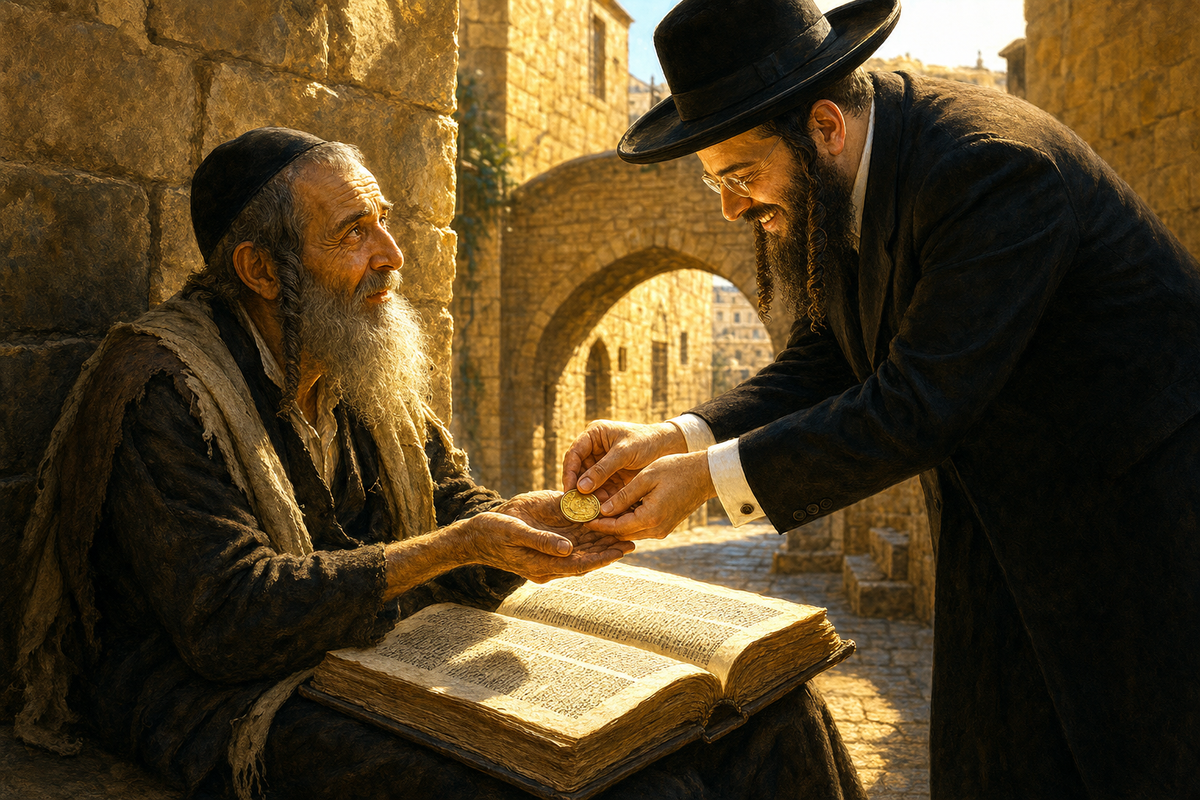
When a person sees someone coming to ask him for tzedakah, he must run and give immediately, with joy and a good heart, which is the exact opposite of a mean spirit. A person must understand that a great kindness is being done for him from Heaven, because in absolute truth, he is not worthy of this abundance of money and wealth at all.
When a person contemplates this, he can clearly see that the poor man asking him for tzedakah is often thousands of times more of a tzaddik (righteous person) than he is. The poor man sits all day and learns Torah, never leaving the four cubits of Halachah (Jewish law), while the rich man wanders about, trading and engaging in the matters of this world. It is therefore obvious that the abundance truly belonged to the poor man, who is holier and purer.
The Poor Man Comes to Save You
We see righteous people whose lives hang in the balance; they do not have a single penny for their parnassah (livelihood) and they suffer from terrible destitution. The rich man must say to himself: "I am merely the holder of a deposit. I am just a bit quicker and more cunning in business, and I know how to acquire money, whereas the poor man is pure and innocent, never lifting his head from the holy Gemara." In essence, it is the rich man who is withholding and delaying the poor man's abundance.
When a person holds back the abundance that rightfully belongs to others, he brings suffering upon himself. Why are there wealthy people whose lives are filled with suffering, severe illnesses, or troubles with their children? It is because they take the abundance first and withhold it from others.
When the poor man comes to ask for tzedakah, he is actually coming to save the rich man from this suffering. He comes to take the abundance that rightfully belongs to him anyway, and by doing so, he frees the rich man from the Heavenly judgment hovering over him. Therefore, when the poor man arrives, you must run to him and give to him with both hands, because he is your savior.
The Secret of the Connection Between Groom and Bride
According to the teachings of Rebbe Nachman of Breslov, the connection between a chassan (groom) and kallah (bride) is also built upon the foundation of tzedakah. The groom gives charity to the bride by the very fact that he descends to her level, speaks with her, and enriches her with Da'as (spiritual awareness). The holy Zohar in Parashas Pinchas explains that a groom must descend to the bride, exactly as Hashem descends to the Congregation of Israel. Hashem descends to our state of smallness and tolerates all our flaws, and this is precisely the role of the groom—to descend to the bride's level of consciousness and illuminate it.
In the secrets of Kabbalah, the groom represents "Chochmah Ila'ah" (the Higher Wisdom), while the bride represents "Chochmah Tata'ah" (the Lower Wisdom). The only way to connect the Higher Wisdom with the Lower Wisdom is exclusively through the power of tzedakah.
King Solomon merited to attain the perfection of the Lower Wisdom, about which it is said, "The wisest of women builds her house." With the help of this wisdom, he ruled over the demons, the beasts, and the birds, and with it, he built the Holy Temple. How did King Solomon merit all this immense wisdom? In the merit of his trait of tzedakah. Solomon hated ill-gotten gain and scattered his money like stones. He performed charity and justice, and when a person would lose in a court case, Solomon would pay him out of his own pocket. In the merit of distributing his money to charity, he merited to know all the wisdoms in the world.
The Supernal Lights Hidden Within Money
Rebbe Nachman explains in Torah 23, that coins and money are actually tremendous "mochin" (spiritual intellects) that have condensed and descended into the physical world. In its root, money is the highest thing; it is the greatest wisdom, except that it descended and materialized in this world.
There are people who chase after money out of lust, and by doing so, they only darken the Divine spark within it. They do not understand that one must seek the revelation of the supernal lights within money. The more a person distributes his money to tzedakah, the more he purifies the wealth, enabling him to reveal the supernal lights and the greatness of the Creator through it.
Through the giving of tzedakah, a person subdues all the kelipos (impure spiritual husks) and illusions, and merits to draw down an abundance of Da'as and a true connection between the worlds.
Part 1 of 2 — Class No. 206
All parts: Part 1 (current) | Part 2
Subscribe to Our Newsletter
Receive Torah articles and inspiration directly in your inbox