
"When Adar Enters, We Increase in Simcha (Joy)"
The Gaon HaTzaddik Rabbi Eliezer Berland shlit"a on the Greatness of Simcha (Joy)
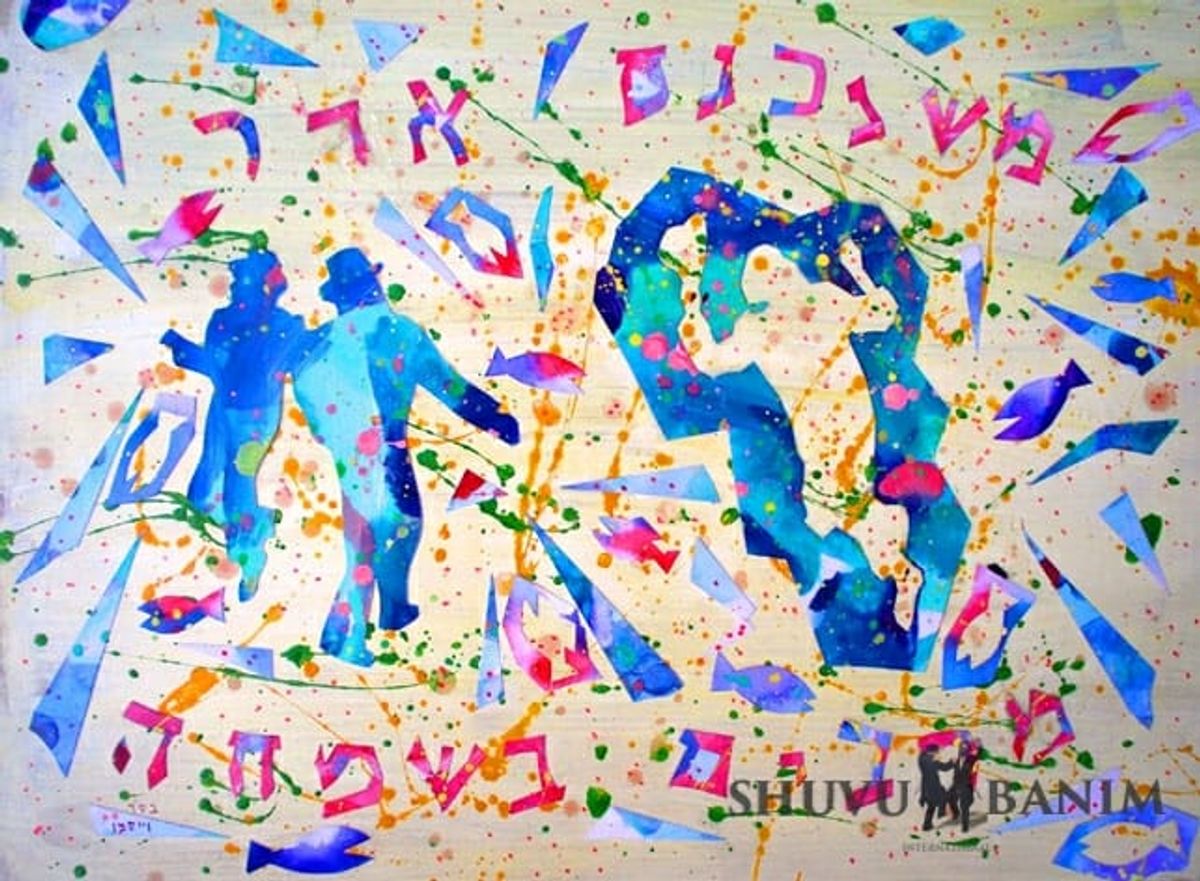
The month of Adar has entered, and the days of Purim, which are of such high stature, are drawing near. In honor of the month in which we increase in joy, we present to you a collection of holy sayings from our teacher, the Gaon and Tzaddik, Rav Eliezer Berland shlit"a, regarding the immense importance of joy.
What is the primary battle in the world?
What can one merit through joy?
Benefits caused by joy
Rebbe Natan of Breslov says that a person's primary labor is the battle against sadness, and for this, one needs self-sacrifice so as not to let sadness take control, ever.
A person says: "It is hard for me to be happy." What, is it only hard for you to be happy? It is hard for everyone to be happy! Joy requires self-sacrifice; a person only reaches joy through self-sacrifice.
It is the work of the Satan that you should not be in joy, that you should not dance and not be happy. Because there are endless reasons to be in sadness, but one must know that a person is covered in all kinds of kelipot (shells), and only joy is what will break those shells. It purifies one from the impurity of death.
Everyone experiences insults and humiliations. The intensity of the adventures that everyone goes through in body and soul, with such great and immense struggle, is such that it is human nature to be in sadness—that is the nature, not to be in joy.
Sadness intensifies until one needs actual self-sacrifice against it, like a person going to sanctify Hashem's name.
Rebbe Nachman of Breslov says in his book 'Sefer HaMiddot' (Joy, Part II, 1): "Whoever is always happy, through this he succeeds." This is the matter of Yosef the Tzaddik, of whom they said in the Midrash that he was a 'gavar kafuz' (a leaping man), and the Matnot Kehunah explains: 'A man who leaps, rejoices, is happy and good-hearted. He leaps over the mountains.' He dances inside the prison. For thirteen years he does not stop dancing. Hashem is with him. He only sees Hashem.
"I will go down with you to Egypt, and I will also surely bring you up." He only sees the 'I am Hashem,' he does not see Egypt, he does not see Pharaoh, he does not see anything; he only sees Hashem. Even though he is alone, and they already drove him from his home, sold him to the Arabs, and now he is in prison on a blood libel, and after all this, he leaps, rejoices, and is happy. Because he is with Hashem. And then Yosef the Tzaddik merits to be one of the seven shepherds. Precisely after everything they did to him, "And Yosef was a successful man."
Through constant joy, one merits to be included in Hashem and to do His will. (Tefillah LeAni. Prayers recorded by our teacher, Rav Eliezer Berland shlit"a)
If a person knew the greatness of the root of his soul, he would fly in the air from the abundance of joy. (Tefillah LeAni)
Whoever does not fall from the rejoicing and joy in Hashem during all his descents merits immense ascents and attainments of Divinity, like one of the great 'bnei aliyah' (those who ascend).
"The main thing is joy, and all the awakenings are only [in order] to serve Hashem with greater intensity and greater strength, and Heaven forbid not to fall from anything, but only to rise and ascend more and more in immense joy, in immense holiness, without end or limit." (Ali Siach. A book containing letters of encouragement written by our teacher, Rav Eliezer Berland shlit"a, over the course of decades)
"...And the main thing is to know that everything must be done with immense joy, without end and without limit, and then you will see salvations, miracles, and wonders, without end and without limit. As it is written, 'To Him who does great wonders alone, for His kindness is forever.'" (Ali Siach)
"Now we only need to strengthen ourselves with all our might in our Rebbe, Rebbe Nachman of Breslov, and to rejoice with him, because the main thing is only the joy in the Rebbe. Besides this, everything is imagination; all worries are imaginations. From all problems, there will only be gladness and joy, and in every person, it is fulfilled that all his days of mourning are transformed into gladness and joy. A person's duty is only to be happy and happy and happy... without limit, just as Rebbe Natan of Breslov writes to his son, that 'you will regret every time you were not in joy.'"
"Because life passes and a person asks himself: Why was I not in joy before? Because everything passes, and everything is only imagination, and the primary obligation is to know this in advance and just to dance and dance, just as our Rebbe, Rebbe Nachman of Breslov, writes that whoever is always happy is victorious." (Ali Siach)
"The main thing is to be like the 'Tam' (the simple one, told by Rebbe Nachman of Breslov in his book 'Sipurei Ma'asiyot'), to be happy with his portion even if it is a shoe with three patches, and to rejoice in Hashem with enthusiasm, because Hashem will not abandon you, and you will rise high in the levels of Torah. You will see immense success in all the work of your hands, and you have nothing to worry about." (Ali Siach)
"The main thing is to maintain constant joy. Even the 'hitbodedut' (personal prayer) must be in such a way that it brings to immense joy, since the entire foundation of our Rebbe is joy, and there is an immense obligation to rejoice in every single mitzvah, and in every good point. And the more we merit to rejoice more and more, so we will merit more and more to attain all good and to ascend higher and higher in Torah and fear of Heaven. Because complete trust—the feeling that Hashem is with us constantly, and that we must not let any thought of sadness enter us, not to be poor in knowledge, but only happy with immense, infinite joy." (Ali Siach)
"And the main thing is never to forget to strengthen ourselves each time with extra joy, and to believe with complete faith that everything that happens to me is for my benefit, and not to grieve too much about anything, only to strengthen ourselves in the joy of Hashem all day, and then we will see the salvations of Hashem wherever we turn." (Ali Siach)
"We must be so careful of sadness, just as one is careful of the greatest enemy, and not let sadness approach me in any way." (Ali Siach)
"And the main thing is to know that every time a person needs salvation, they test him from Above. And the main test is that they bring him some situation, and they want to see if he will indeed strengthen himself with true joy; and when he truly strengthens himself, then it is a sign that he truly wanted to do the will of Hashem. Because when a person strengthens himself in joy, it is a sign—so I heard from R' Betzalel Friedman—that he is indeed truly seeking at every moment to do the will of Hashem, and therefore what does he care where he is, and what is done with him? After all, at every moment I must bring pleasure to my Creator and Maker, and if so, at this moment I must bring Him pleasure by strengthening myself with extra, infinite joy, and feeling truly the kindness of Hashem that He has done with me, and that He does with me at every moment." (Ali Siach)
Subscribe to Our Newsletter
Receive Torah articles and inspiration directly in your inbox