
The Deep Trap of Achashverosh and the Secret of Daniel's Advice
Class No. 233 | Cassette Archive No. 233, Sunday, Parashas Vayakhel, the eve of the 22nd of Adar I, 5760 - A class at the opening of the Breslov Kollel for young men.
Achashverosh hosted the royal banquet to test whether his kingdom was firmly established and whether the Jewish people, Heaven forbid, would be annihilated. When Vashti refused to appear, he found himself in a fateful trap. The solution came specifically through the wisdom of Daniel, who maneuvered Haman into sealing her fate, thereby heralding the rebuilding of the Beis HaMikdash (Holy Temple).
Achashverosh sought a sign that his kingdom would endure. The sign among them was that if seventy years passed and he merited to see children, grandchildren, and great-grandchildren, it would prove that he truly ruled, similar to Nebuchadnezzar who merited four generations. Beyond this, there was a deeper problem: the entire world was afraid of the Jewish people.
The nations live in daily fear of the Jews, for they know that ultimately, the Jewish people will rule the world. "Every moment that the Jews are still alive, the nations of the world are in terrible fear." They see that the Jewish people live and have been waiting for two thousand years, and according to all the holy books and the Tanakh (Hebrew Bible), the Jewish people are destined to rule over the entire world.
It is a fact that the Jewish people cannot be destroyed. Many nations have already been wiped out or replaced—the English and French of the past are not the same as those of today. But there is one nation that does not assimilate, "and it is like pure gold that does not bond with any other metal—the Jewish people cannot be destroyed." Therefore, the world is in constant fear of the day when the Jewish people will reign.
The Trap of Achashverosh at the End of the Banquet
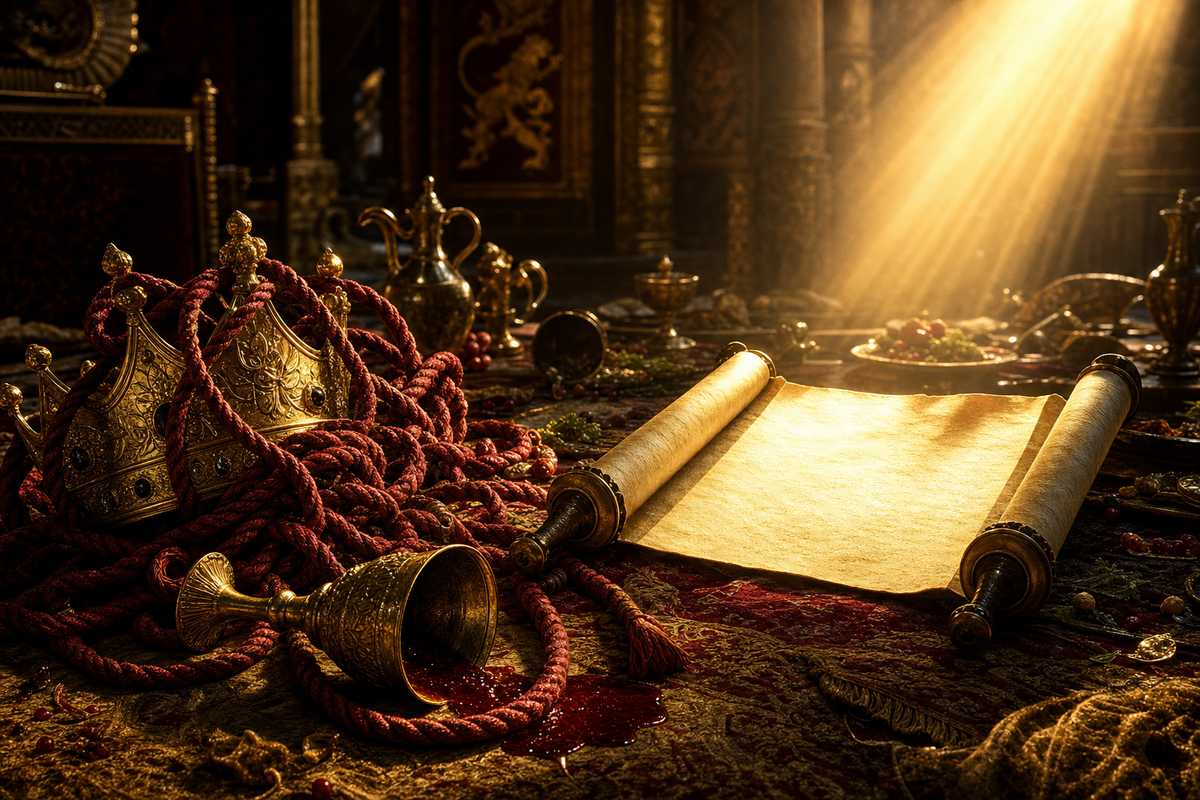
Achashverosh was also gripped by this same fear. According to the words of the Chasam Sofer, this was one of the central signs of his banquet. He brought out all the vessels of the Beis HaMikdash and wore the garments of the Kohen Gadol (High Priest). His thought was that if the banquet passed peacefully, it would be a clear sign that he would indeed rule the world, and the Jewish people, Heaven forbid, would be eliminated and disappear.
But what happened at the end of the banquet? At the very last minute, after everything had gone wonderfully and he already saw all the signs that he was the king of the world—his wrath burned within him. Achashverosh found himself in a situation where he did not know what to do.
He had established two signs for himself: if there was a disruption at the end of the feast, it would be a sign that he could not control the Jewish people, that the Beis HaMikdash would be rebuilt, and that he would not remain king. Now, if he were to hang Vashti, it would serve as a double sign that he had no true kingship and that the Beis HaMikdash was destined to be rebuilt. On the other hand, if he did not hang her, it would mean that she had humiliated him and that she was the one ruling over him.
The Silence of the Advisors and the Dilemma of the Sanhedrin
No one knew how to solve this complicated question. All the nations and advisors were afraid to intervene, for the Targum Sheni brings down that Achashverosh did indeed ultimately kill all his advisors—Shesar, Tarshish, Admasa, and all the rest. They were afraid that if they told him to hang Vashti, he would be angry at them for causing a disruption at the feast and bringing about a bad omen. And if they told him not to hang her—what would become of the king's honor?
Hashem arranged a trap here that was impossible to escape. When all the advisors evaded the issue, Achashverosh called for the Sanhedrin (the supreme Jewish court), to the tribe of Yissachar who were "knowers of the times." He wanted to inquire of them what to do regarding Vashti's sin, and perhaps through them understand if the time for the Geulah (Redemption) and the rebuilding of the Beis HaMikdash had arrived.
The Sanhedrin knew that it was impossible to get out of this entanglement. Any advice they gave would lead to the king ultimately hanging them, claiming they had given bad advice. Beyond that, there was a great fear that if the Sanhedrin said to hang Vashti, the king would suspect them of acting out of personal bias, because they wanted the Beis HaMikdash to be rebuilt and for the greatest wicked woman of the generation to die.
The Wisdom of Daniel and the Advice of Haman
Here the Chasam Sofer explains how the contradiction was resolved. Among the sages of the Sanhedrin sat Daniel, who was the wisest of them all and surpassed everyone in his wisdom. Daniel, who was the head of the Sanhedrin at the time, understood the danger and devised a brilliant piece of advice.
"The Chasam Sofer says: Daniel said, 'I have an idea, let us give this advice to Haman.' After all, Haman also wants to get rid of Vashti, because he had a personal interest—he had a daughter whom he wanted to be chosen as queen."
Daniel knew that Haman had a clear interest, but he himself was afraid to give the advice lest he be suspected of wanting to bring in his own daughter. Therefore, Daniel decided to convince Haman, who is also known as Memuchan, that he should be the one to give the advice to the king.
Regarding this, the Gemara says: "Memuchan is Haman."
Daniel knew that the king would not touch Haman. And indeed, Achashverosh harmed all the advisors—Shesar, Marsena, Tarshish, and Admasa—but he did not touch Haman. This move was crowned with tremendous success, and ultimately, the hanging of Vashti was the clear sign that, with the help of Hashem, the Beis HaMikdash would be rebuilt speedily in our days, Amen.
Part 2 of 2 — Class No. 233
All parts: Part 1 | Part 2 (Current)
Subscribe to Our Newsletter
Receive Torah articles and inspiration directly in your inbox