The License Revocation That Was Sweetened for a Can of Beer
Every Thursday, the holy gathering takes place at the Nachalei Netzach Yeshiva, where members of the holy congregation assemble to hear stories about the tzaddik. They strengthen themselves through friendly conversation about the immense merit we have to be connected to such a Rebbe, and to have our teacher, the Rav, the true tzaddik of the generation. Each week, one of his students is called upon to recount the praises of the tzaddik. This time, the members of the gathering merited to hear firsthand miracles from the tzaddik's attendant (gabbai), Rabbi Barak Natan Barber shlit"a.
During his talk, Rabbi Barber shared a wondrous miracle that happened to him when the Rav was in the holy city of Tiberias. Those were the days when the Rav would occasionally go out at night to visit the graves of tzaddikim in the north. Sometimes it was the grave of Rabbi Chiya and his sons, and sometimes the grave of Rabbi Yonatan ben Uziel in Amuka, among others.
"One evening," Rabbi Barak Natan Barber began his story, "the Rav instructed me to sleep at a relative's house in Yavne'el, so that I could be back with him by one o'clock in the morning to travel to the grave of Rabbi Yonatan ben Uziel in Amuka. The plan was for me to arrive at the street where the Rav's apartment was located at the time, and the Rav's driver would flash his lights so I would know where he was and could follow the Rav. The driver for that trip was R' Eliyahu Shitrit, may Hashem protect and sustain him. Indeed, at one o'clock I was in Tiberias. R' Eliyahu signaled their location by flashing the car's headlights, and we began a fast drive toward Amuka, with me driving closely behind the Rav.
"At one of the turns before Chatzor, a police officer stopped the car in front of me, which, as mentioned, carried the Rav. However, when I turned in behind the Rav, the police officers left the Rav's car and approached me, saying loudly, 'It's not that one, it's this car.' It turned out they had seen a car driving at a speed of 130 km/h on a road with a maximum speed limit of 90 km/h, but they were unsure which of the two vehicles had committed the offense. For some reason, they decided that I would receive the punishment. They confiscated my driver's license and told me to come to the Beit Dagan police station the next day, where they would decide what to do. Usually, the maximum penalty for this is a thirty-day license revocation.
"We continued to Amuka, with a friend taking over the driving for me. When we arrived at the gravesite of Rabbi Yonatan ben Uziel, I began to cry bitterly over what had happened to me, and I fell into sadness. At the time, I lived in Jerusalem and worked in Holon, and the thought of having to go thirty days without a driver's license was very difficult for me. The Rav saw that I was sad and told me not to worry—we would pray, and with Hashem's help, everything would be fine.
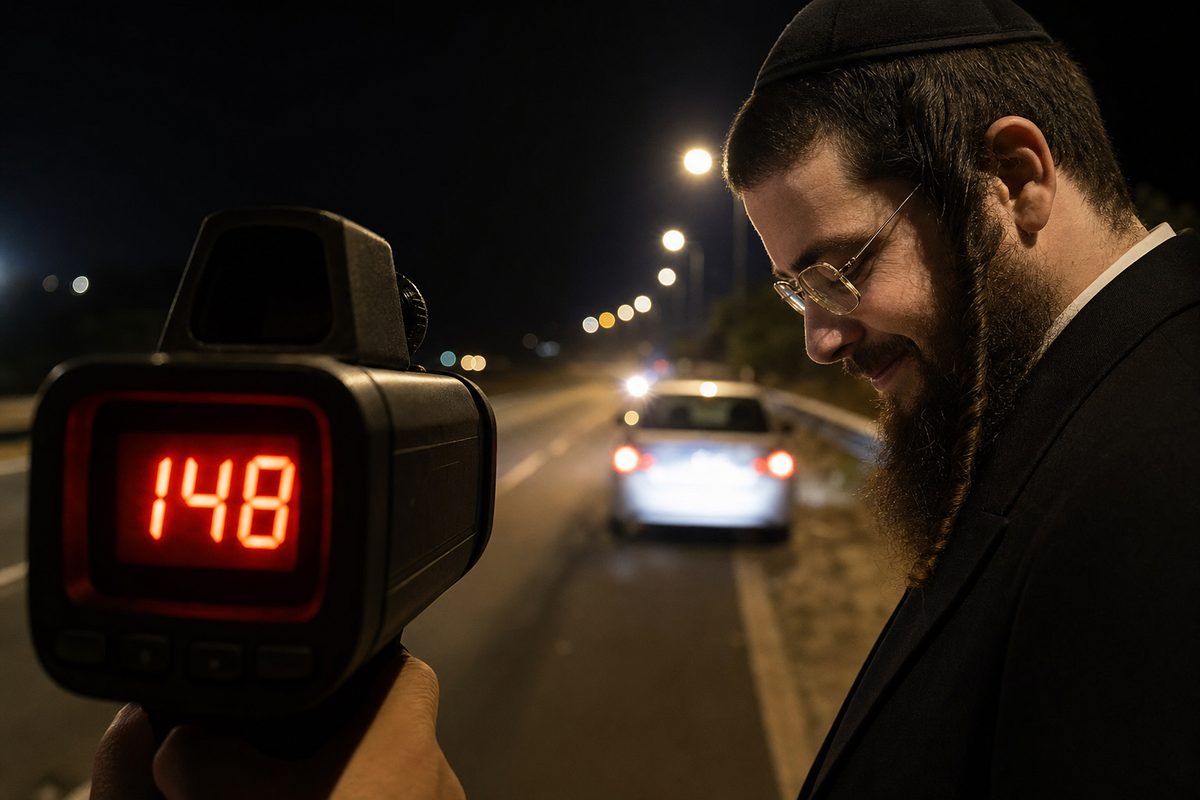
"After we prayed at the gravesite of the holy Tanna, we headed back toward the city of Tiberias. The Rav left with R' Eliyahu Shitrit, while I lingered for a few minutes and left after them. After driving a few kilometers, I saw the Rav's car on the side of the road. Just a few minutes earlier, a traffic cop had stopped them and pulled them over. I also stopped nearby and walked over to the Rav. Meanwhile, I noticed that the display on the police officer's laser speed gun showed that the Rav's car had been traveling at a speed of 148 km/h.
"I looked at that number and smiled.
"Every time a Breslov Chassid encounters this number, he feels a sort of personal 'greeting' from Rebbe Nachman of Breslov. The name of our Rebbe—Nachman (נחמן)—has the numerical value (gematria) of 148, and many Breslov Chassidim set their alarm clocks for 1:48 AM to wake up for Chatzos (the midnight lament over the destruction of the Temple). I felt that something good was happening to me, and I looked at the holy face of the Rav. The Rav told me, 'I swapped your license revocation with Eliyahu Shitrit.'
"I understood that what had happened was that only Eliyahu Shitrit would receive a revocation, while I would emerge to a good and peaceful life. Even though it didn't seem likely that they would let me off so easily, and the probable forecast was that both of us would lose our licenses since there was no connection between my case and his, I believed with all my heart in the Rav's words. I began to rejoice that I wouldn't lose my license at all.
"The next day, I arrived at the police station, and inexplicably, they decided to return my license until the trial date. Sometime later, the date of the trial arrived at the courthouse in Safed. I arrived and saw that the judge was Arab, the prosecutor representing the state was also Arab, and all the drivers who were judged before me received a two-year license revocation. I felt that the attribute of strict judgment was stretched taut here, and I prayed to Hashem that in the merit of the Rav's blessing, a miracle would happen and I wouldn't receive a revocation at all.
"After a long wait, the judge went on a break, and my trial was scheduled to take place immediately after the break. Meanwhile, the Arab prosecutor was organizing his papers and case files. Then he turned to me and said, 'Are you Barak? Have you been holding onto your license until the trial?' I replied that indeed, the police had returned my license until the trial date. He continued to look through the files and said, 'Then we'll make sure you get a three-month revocation!'
"I didn't know whether this was bad news or good news. After all, the people before me had received two years. But on the other hand, I held fast to the blessing of the Rav, who said I wouldn't receive a revocation at all.
"Suddenly, a friend of Sharon Koheli arrived at the scene. Sharon has been a good friend for years, and his friend recognized me and apparently felt obligated to help me. He approached the prosecutor and began to explain to him that there was no logic in giving me a three-month revocation. Truly, after a long argument, the prosecutor agreed to compromise on two months. For some reason, Sharon Koheli's friend wasn't satisfied with this and continued to insist until the prosecutor agreed to waive the revocation request entirely, settling for a fine of only 1,500 NIS.
"I left the courthouse happy and in good spirits. Although the fine amount was high, dealing with a revoked license—especially during a period when the Rav was in the north and I was commuting between Jerusalem and Holon—would certainly have been a much greater hardship. And just as the Rav had said, that I wouldn't receive a revocation, so it was.
"Sharon Koheli's friend walked out of the courthouse after me, approaching me radiating joy; he had managed to help a friend in just a few minutes. Then he said to me: 'How much would a lawyer have cost you to get the deal you just got? A few hundred shekels at least, right?!
"'So what am I asking for... just buy me a can of beer and we'll drink a l'chaim.'
"Thus, the harsh decree of the license revocation was sweetened (mitigated) with a can of beer.
"L'chaim, l'chaim."
From the book "Pele Elyon, Part 3"
Read more
Subscribe to Our Newsletter
Receive Torah articles and inspiration directly in your inbox