
The Secret of Free Will: Why is the Evil Inclination Called "Very Good"?
Lesson No. 260 | Cassette No. 260 Friday morning, Parashas Re'eh, 24 Av 5760 in the Yeshiva Monday, Parashas Re'eh, 20 Av 5760, Bris in Telz-Stone Old lesson for children, Lesson No. 1
The Vilna Gaon explains the difference between a person who is the "Tree of Life" and a person who is the "Tree of Knowledge." Through a wonderful parable about a worker in a coal mine, it is explained why a person's true reward begins specifically from struggling with the Evil Inclination and choosing good, and how this was also the case with the Jewish people after the sin of the Golden Calf.
The Tree of Life and the Tree of Knowledge
The Vilna Gaon zt"l (of blessed memory) writes that there are two types of people: there is a person who is in the aspect of the "Tree of Life," and there is a person who is in the aspect of the "Tree of Knowledge," and there is a person who is comprised of both trees together. For a person who is in the aspect of the Tree of Life, evil cannot enter his domain at all. He does not even have a fleeting thought to sin, and evil is simply incapable of penetrating him.
Rebbe Nachman of Breslov says in Sichos HaRan that if we leave a person alone in a forest or a desert, even if he has the most burning Evil Inclination, he will fulfill the entire Torah and overcome it. It is only when there are two people that one looks at the other and says, "This is permitted for him, and this is permitted for him." Naturally, a person hates the Evil Inclination and cannot stand it. If a person is even slightly holy and pure, the Evil Inclination cannot enter his domain at all, because his thoughts are directed toward the good, both at the beginning and at the end.
This is hinted at in the Midrash (Koheles Rabbah 3:11) on the verse:
"And Hashem saw all that He had made, and behold, it was very good."
The Midrash says: "And behold, it was good" – this refers to the Good Inclination; "very good" – this refers to the Evil Inclination. Why is the Evil Inclination called "very good"? Because in truth, a person's reward only comes when he has an Evil Inclination. When a person only has a Good Inclination, he receives no reward for his actions, because he faces no struggle.
The Parable of the Coal Mine and the Hotel
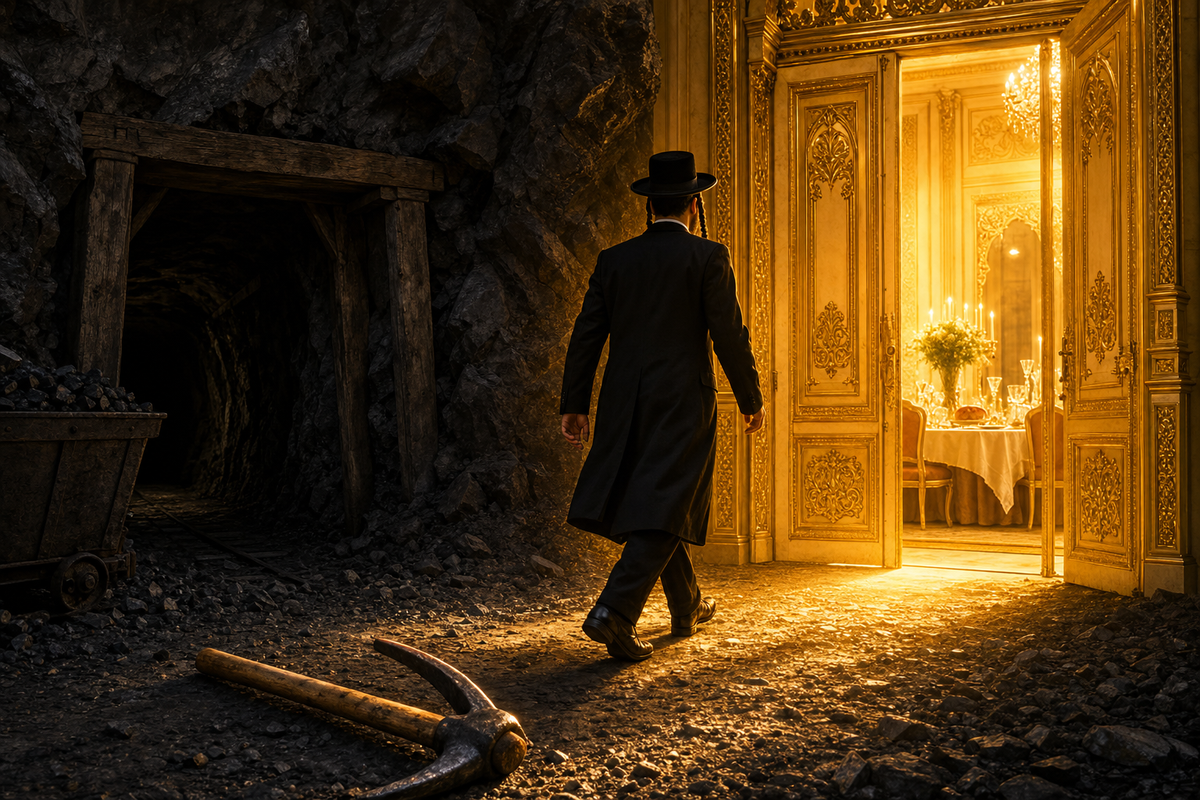
Rebbe Nachman writes in Torah 8 (Likutey Moharan) on the verse "My spikenard yielded its fragrance," that when Moshe Rabbeinu came down from the mountain and said to the Jewish people, "You made a Golden Calf," it was specifically then that their reward began. To understand this, let us imagine a person who worked in a coal mine for sixteen hours a day. One day, someone comes to him and says: "Come, I will put you in a hotel made entirely of gold, with golden goblets; you will eat and drink for free. There is only one condition: on Shabbos, do not turn the lights off or on."
Friday night arrives. The worker wants to fall asleep, but the light is on and bothers him. Or conversely, the following Shabbos he decides to leave it dark, but then he wants to read a book and has no light. He experiences five minutes of distress. This tiny drop of distress that he experiences on Shabbos atones for the entire sin of Adam HaRishon (the First Man), who brought darkness to the world.
Had it not been for the sin of Adam HaRishon, the Hidden Light would have illuminated the world forever. Because of the sin, the Hidden Light was darkened. When does a person atone for this? On the holy Shabbos. This small distress of keeping Shabbos, when the light or darkness isn't exactly to his liking, atones for things that are infinite.
Free Will Gives Birth to the Reward
Now, another person comes and says to that worker: "Why do you need this hotel with Shabbos observance? There is another hotel right across the street, for free, without any Shabbos restrictions." The worker moves to the second hotel, but when Shabbos arrives, he begins to long for the holy Shabbos. He realizes that it is not worth it just for the convenience of turning the lights on and off. He leaves the second hotel and returns to the first.
Only now, when he has returned out of his own free will, do they begin to give him a reward. Previously, when he left the coal mine, he did not deserve any reward because he had no choice—he simply received a free hotel. But the moment he was given the option to choose another hotel, and he chose to return and observe Shabbos with love, this is where true free will begins, and this is where the reward begins.
The Reward of the Jewish People After the Sin of the Golden Calf
This is exactly how it was with the Jewish people when they left Egypt. They received everything for free: the Clouds of Glory, Miriam's Well, quail, and Manna falling from heaven. They did not deserve any reward for this. Then came the Erev Rav (mixed multitude), Yunus and Yambus (the sons of Bilaam), and said to them: "Why do you need Moshe Rabbeinu? We have a calf that can bring down rain and give you water in the desert."
According to the Zohar and the Arizal, the soul of Bilaam ben Beor was impregnated within this calf, and it jumped, danced, and proclaimed, "I am Hashem your God." The Jewish people broke down and made the Golden Calf due to a miscalculation of six hours, when the Satan showed them Moshe's bier floating in the air, and they were certain he had died.
When they saw Moshe Rabbeinu return, they experienced such profound heartbreak that, out of sheer distress, they felt they could no longer fulfill the Torah. But Moshe said to them: "On the contrary, now your reward begins!" Until now, you walked in the desert and received everything for free. Now, when you could have gone on new paths and chosen new leaders, yet you broke your hearts and returned to me—now the reward begins.
This is the secret of the verse:
"While the King was at His table, my spikenard gave forth its fragrance."
Chazal (the Sages) refer to this as "a wretched bride who commits adultery within her bridal canopy." Even though they sinned in the middle of the chuppah (bridal canopy), while the mountain was burning with fire, specifically through the brokenness and the return in teshuvah (repentance), they merited to reach the level of true free choice and to receive the complete reward.
Lesson No. 260
Subscribe to Our Newsletter
Receive Torah articles and inspiration directly in your inbox