The Secret of the Hidden Light and the Power of the True Tzaddik
Lesson No. 151 | * Motzaei Shabbos Kodesh Parashas Eikev, the eve of 24 Menachem Av 5758 - A lesson for the youth organization and 'Sheva Brachos' (seven wedding blessings)
A profound discourse explaining the secret of the immense light that hovers over a chassan (groom) and kallah (bride) during the chuppah (wedding canopy), and the spiritual war surrounding the holiness of procreation. Through a wondrous story of Divine Providence, it is revealed how the difficulties and sufferings in the world are meant to awaken a person to search for the true tzaddik who will sweeten the harsh judgments from upon him.
It is an immense privilege to know the inner essence of Sheva Brachos and the chuppah. The secret of a chassan and kallah is higher than high. Reb Noson of Breslov says about this:
"No thought can grasp it at all."
No thought, no angel, and no seraph can comprehend to which spiritual worlds the chassan and kallah ascend during their chuppah.
A Light Beyond Intellectual Grasp
When the blessing is recited under the chuppah:
"Bring great joy to these loving friends, just as You gladdened Your creation in the Garden of Eden from of old."
The chassan and kallah ascend to the spiritual worlds that existed before the sin of Adam HaRishon (the First Man), to the place where the ministering angels would roast meat and pour wine for him. Throughout the seven days of feasting, they exist in the dimension of time before the sin, in the secret of "Nikras HaTzur" (the cleft of the rock).
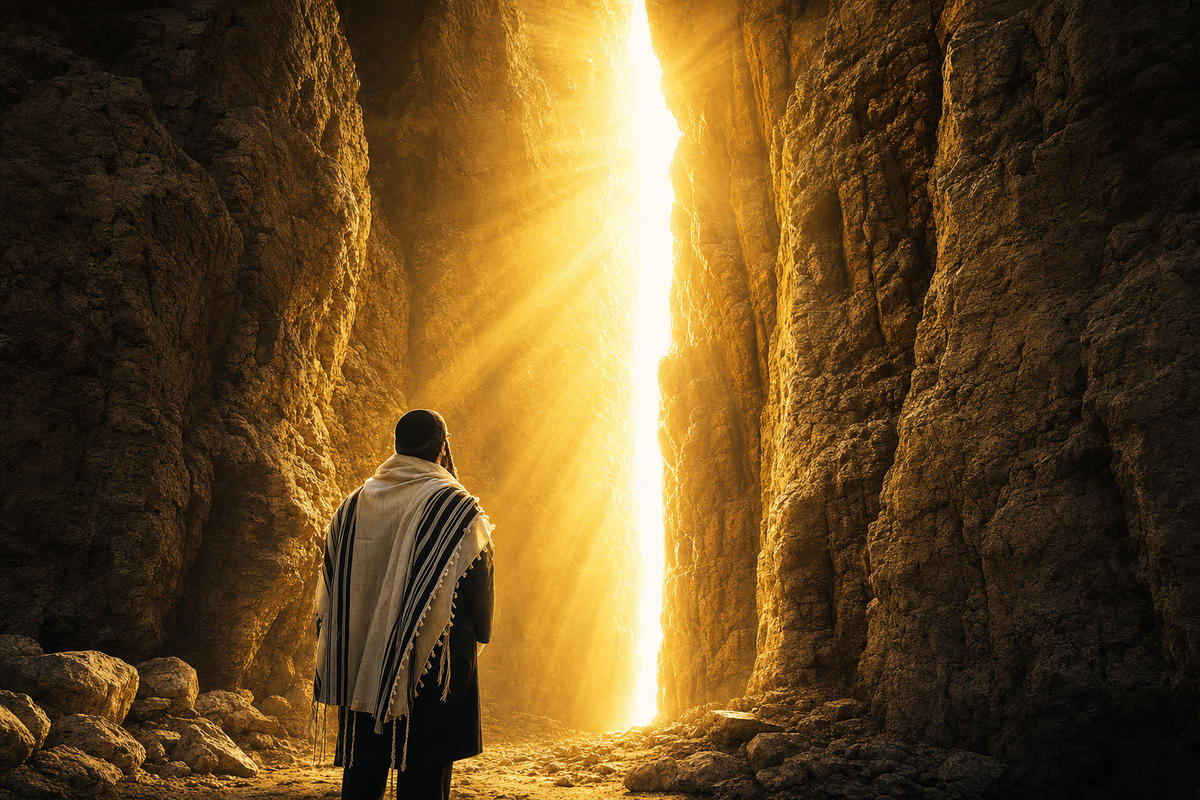
The chassan and kallah are situated in the secret of the time when Hashem placed Moshe Rabbeinu into the cleft of the rock. Regarding this, the Gemara (Megillah 19b) states that if there had been even a single tiny hole in the cleft of the rock, the entire world would have been consumed by the sheer intensity of the light. The light that surrounds the chassan and kallah is so immense that if we were to see even a single drop of it, we would be burned up.
This is the secret of the cleft of the rock of the chassan and kallah. There, the Or HaGanuz (Hidden Light) was revealed to Moshe Rabbeinu, and from it, "the skin of his face shone." Every chassan and kallah ascend to worlds where there is no intellectual grasp whatsoever, above the world of Atzilus (Emanation) and above all four spiritual worlds. This immense light radiates upon everyone around them. Therefore, sins are forgiven not only on the day of the chuppah, but throughout all seven days of feasting. Anyone who participates in the joy of a chassan and kallah has all their sins forgiven, and in this merit, may we merit the complete Geulah (Redemption) speedily in our days.
The War Over the Holiness of Procreation
The direct continuation of the holiness of marriage is the holiness of procreation. When the time arrives for Pidyon HaBen (redemption of the firstborn son), it is the moment to bring down all the "firstborns of Egypt"—all the forces of impurity. The Jewish people are called "My firstborn son, Israel," and through the mitzvah of Pidyon HaBen, whose value is 84 (Peh-Daled) selaim (coins) corresponding to 84 fasts and the gematria (numerical value) of "Chanoch," we merit to receive the "Zihara Ila'ah" (the Supernal Radiance) of Chanoch.
At the exact moment we redeem the son, all the firstborns of Egypt fall. Reb Noson explains (Hilchos Bechor Behemah Tehorah 3) that our entire spiritual work is to sanctify procreation. The entire war of the evil inclination is concentrated on the matter of procreation. The S"M (the primeval angel of evil) received permission to defile a person from the very first stages of his formation, and as Rebbe Nachman of Breslov brings down (Likutey Moharan, Torah 10), a person can become defiled with endless impurities while still in his father's mind.
The Supernal Desire of the Creator
In order to escape impurity and merit holiness, we need the power of the true tzaddik. Rebbe Nachman says that the haughty ones delay the desire of Hashem. Not everyone knows how to stand before the Creator, and not everyone's prayer is accepted. There are only unique individuals in each generation whose prayers pierce the heavens.
Those haughty individuals, even if they are considered righteous, learned, and holy—who says they know the secret of standing before Hashem? Who says their prayer is actually accepted? In their arrogance, they hold back the supernal desire of Hashem.
And what is this desire of Hashem? The first desire is that He should have a dwelling place in the lower realms. But beyond that, Hashem desires the prayers of the tzaddikim. The Creator has a tremendous and immense desire, so to speak, to hear the voices of the true tzaddikim.
For this exact reason, Hashem brings difficulties upon a person. He makes people sick, withholds their parnassah (livelihood), and even makes them barren. We find this with the Patriarchs and Matriarchs—Avraham, Yitzchak, and Yaakov, Sarah, Rivkah, and Rachel—who were barren because Hashem desired their prayers.
A Gift from the Darkness
To illustrate how difficulties bring us back to the right path, I will share a story that I witnessed up close. There was a young man, a relative, who was endowed with rare talent. In his childhood, he was considered a tremendous prodigy; he knew Mishnayos and Gemara by heart, and studied in the Ponevezh Yeshiva. However, the evil inclination enticed him. He made a financial calculation and decided that instead of remaining in the Kollel, he could utilize his brilliant mind in the computer world and earn a fortune.
He left the world of Torah, studied programming, and became a genius in his field. After his wedding, a millionaire approached him and offered him a partnership in establishing a massive computer enterprise. That young man, who had already forgotten about Hashem and thought he could manage on his own, signed guarantees totaling twenty million shekels with the banks. The moment the money was received, the partner fled the country, leaving him with enormous debts.
The police and the banks pursued him, and he was forced to flee Israel. He wandered from the United States to Canada, from there to Australia, and finally arrived in New Zealand, where he received citizenship. About a year and a half ago, one of the largest oil drilling companies in the world offered him a massive contract to be their chief programmer for the entire Middle East. It seemed he was about to become one of the wealthiest people in the world.
But just one month after signing the contract, he fell ill with a terrible disease. The doctors determined that his chances of recovery were zero, and he had only a few months to live. He lay in his bed, helpless, unable to move or work.
In this critical condition, with death hovering over him, he began to do teshuvah (repentance). He started keeping Shabbos and putting on tefillin. I spoke with him on the phone, and he told me a chilling sentence: "I received a gift from Hashem. Hashem loves me and brought me back to Him. I no longer care if I live or die; the main thing is that I have returned to the Creator of the world and started fulfilling mitzvos."
The moment he truly accepted upon himself the yoke of Heaven, a miracle occurred. His condition began to improve miraculously. He got out of bed, returned to functioning, and even made a decision to travel to the gravesite of Rebbe Nachman of Breslov in Uman—something that in the past, when he was distant, would have seemed inconceivable to him.
The Purpose of All Suffering in the World
This story illustrates the spiritual reality of our world. All the illnesses, crises, and suffering that people endure are meant for one purpose: to awaken a person to return to Hashem, may He be blessed, and to search for the true tzaddik who can save him.
When a person reaches the true tzaddik, that tzaddik whose prayer Hashem anticipates and yearns for, salvation occurs. There are many people who are righteous, holy, and pure, who study Torah day and night and afflict themselves. But there is a profound difference between being a holy person and being the tzaddik whose prayer pierces through all the barriers and is accepted immediately.
Hashem brings troubles upon a person so that he will go to that tzaddik and tell him his pain. Thus, the tzaddik is awakened to mercy, sheds tears over the sorrow of a Jew, and prays for him from the depths of his heart. This is the ultimate desire of the Creator of the world—to hear the pure prayer of the true tzaddik, through which all salvations and healings are drawn down to the world.
Part 3 of 3 — Lesson No. 151
Subscribe to Our Newsletter
Receive Torah articles and inspiration directly in your inbox