
The Secret of the Mount Sinai Experience of the Groom and Bride
Lesson No. 151 | * Motzaei Shabbos Kodesh Parashas Eikev, the eve of 24 Menachem Av 5758 - A lesson for the youth organization and 'Sheva Brachos' (seven wedding blessings)
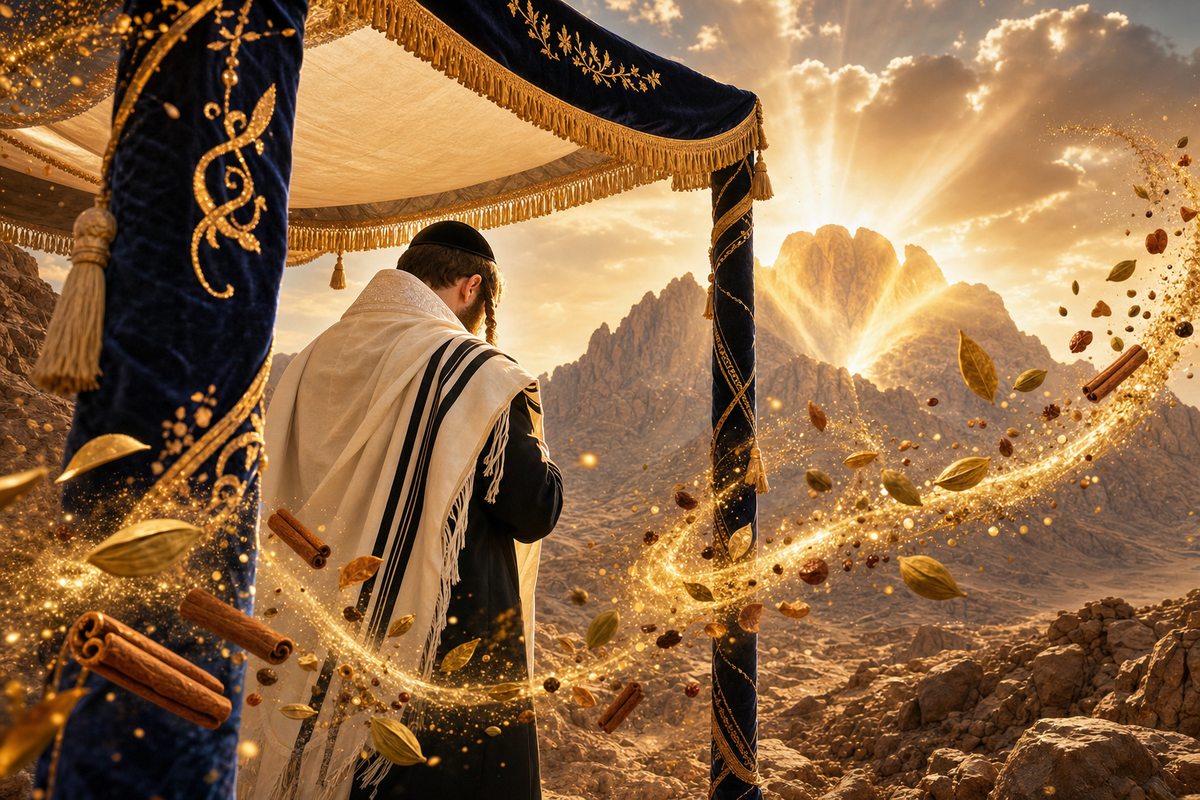
Every Jewish wedding is an exact reenactment of the revelation at Mount Sinai, where the groom and bride are compared to the Two Tablets of the Covenant. During the chuppah (wedding canopy) and the Sheva Brachos (seven wedding blessings), the entire world is filled anew with the spiritual fragrance of the Ten Commandments, and the souls are elevated to the level of the primordial Garden of Eden.
In Parashas Eikev, we read about the Ten Commandments and the Two Tablets of the Covenant. The Torah sometimes calls them "Tablets of Stone" and sometimes "Tablets of the Covenant." Moshe Rabbeinu (Moses our Teacher) describes: "Hashem gave me the two tablets of stone, written by the finger of God." After the sin of the Golden Calf, when Moshe descends from the mountain, the tablets lose their original holiness—they are left without the covenant and without the stones, until Moshe shatters them. Only afterward does Hashem command him to carve tablets of stone like the first ones.
The Groom and Bride – The Two Tablets of the Covenant
The Midrash Rabbah reveals a tremendous secret: Every groom and bride are the spiritual aspect of the Two Tablets of the Covenant. When the Torah says, "When He finished (k'chaloso) speaking with him," the word "k'chaloso" is expounded as being related to the word "kallah" (bride). The two supernal tablets that bridge heaven and earth are the secret of the groom and bride.
Rebbe Nachman of Breslov teaches in Likutey Moharan (Torah 86) that every wedding of a kosher groom and bride is literally the spiritual aspect of the revelation at Mount Sinai. The seven days of feasting correspond to standing at Mount Sinai. The dances at a wedding are not ordinary dances—these are angels dancing. The wedding hall is filled with angels, and the joy is the aspect of a ladder set upon the earth, whose top reaches the heavens.
The Fragrance of the Ten Commandments
The holy book "Megaleh Amukos" explains that all the prayers and supplications of Moshe Rabbeinu in Parashas Va'eschanan were for the groom and bride, from whom the King Mashiach will come. Rabbi Nosson of Breslov adds that the main joy at a wedding is the emunah (faith) that Mashiach will sprout from this couple.
During the wedding, the entire world is filled with spiritual fragrances, exactly as it was at the Giving of the Torah. The Talmud in Tractate Shabbos states that at the time of the Giving of the Torah, with every single utterance that emerged from the mouth of Hashem, the entire world was filled with the fragrance of spices. Hashem had to pass a special wind to clear the air and make room for the fragrance of the next utterance.
This is exactly what happens during the Sheva Brachos: Every day of the seven days brings with it new fragrances. One who merits it can literally smell these spiritual fragrances when sitting next to the groom and bride.
The Reaction of the Nations of the World to the Commandments
When Hashem said, "I am the Lord your God," the nations of the world heard it. At first, they thought this was just another deity demanding honor for itself. When He said, "You shall have no other gods before Me" or "Observe the Sabbath day," they still assumed this was a god seeking exclusive worship.
But when the utterance "Honor your father and your mother" arrived, they realized there was a tremendous novelty here. Unlike idolatry, where fathers would be sacrificed to the Molech, here God commands to honor them. And when they heard "You shall not murder" and "You shall not steal," the Talmud in Tractate Zevachim says that they literally sang a song of praise.
However, their joy did not last. When they understood the full implication of "You shall not steal" and "You shall not murder," they were seized with anxiety. They could not fathom how it was possible to live in a world without robbery and wars. They immediately ran to the wicked Bilaam and asked him if Hashem was about to destroy the world. Bilaam calmed them and told them: "Hashem will give strength to His people"—the Torah was given only to the Jewish people, and you can continue with your ways.
The Eternal Fragrance of "You Shall Not Covet"
The holy book "Beis Yisrael" and other early works bring a wondrous insight regarding the tenth commandment—"You shall not covet." While Hashem cleared away the fragrance of the first nine commandments to make room for the next utterance, He left the fragrance of "You shall not covet" for all eternity.
For a Jew who stood at Mount Sinai, there is truly no reality of coveting. Every Jew, in the depths of their soul, is happy with their lot and satisfied with what is theirs. The fragrance of this utterance remains imprinted within the souls of the Jewish people forever.
Hearing the Voices of Mount Sinai
During a wedding, the voices of Mount Sinai echo once again. The Talmud (Berachos 6b) states: "Anyone who brings joy to a groom and bride merits five voices, as it is stated: The voice of joy and the voice of gladness, the voice of the groom and the voice of the bride..."
A person who goes to bring joy to a groom and bride passes through these five voices, which correspond to the voices at the Giving of the Torah. The "Beis Yisrael" of Gur was meticulous about attending every Sheva Brachos celebration. In his old age, when he could no longer walk, he would ask anyone who returned from a Sheva Brachos to stand next to him, so that he could smell from them the fragrance of the Giving of the Torah.
He used to say: "What is bitul Torah (neglecting Torah study)? Right now, we are hearing the Ten Commandments! New mochin (levels of consciousness) are opening up!". Whoever brings joy to a groom and bride merits that a new Torah is revealed to him, exactly like the morning of the Giving of the Torah, about which it is said, "And there were thunders and lightnings."
The Elevation of the Souls to the Garden of Eden
The Gemara adds that whoever brings joy to a groom and bride is "as if he offered a thanksgiving offering" and "as if he rebuilt one of the ruins of Jerusalem." The Maharal of Prague explains that the thanksgiving offering is connected to the nullification of chametz (leaven) and its transformation into matzah, similar to the holiday of Shavuos and the Giving of the Torah.
At a wedding, all physicality is nullified. The groom and bride are not seeking physicality; they are in the supernal worlds. The "Megaleh Amukos" points out that the word "Chasan" (groom) has the same numerical value in gematria as "Shchakim" (heavens) (458). The groom and bride are not in this world at all – their souls are roaming in the heavens, in the primordial Garden of Eden, before the sin of Adam HaRishon (the First Man).
As it is told of the holy Baal Shem Tov, that his body could sit and speak with people while his soul ascended to the supernal chambers or recited Chatzos (the midnight lament) in another place – so too are the groom and bride. They stand under the chuppah (wedding canopy) as pure souls without a body, and the entire world is filled anew with the fragrance of the spices of the Garden of Eden and the Giving of the Torah.
Part 1 of 3 — Lesson No. 151
Subscribe to Our Newsletter
Receive Torah articles and inspiration directly in your inbox