
The Secret of the Holiness of the Home: How We Can Merit the Illumination of Matan Torah
Lesson No. 195 | * Wednesday, Parashat Nasso, the eve of the 5th of Sivan 5759 - A lesson at the 'Meshivat Nefesh' Yeshiva
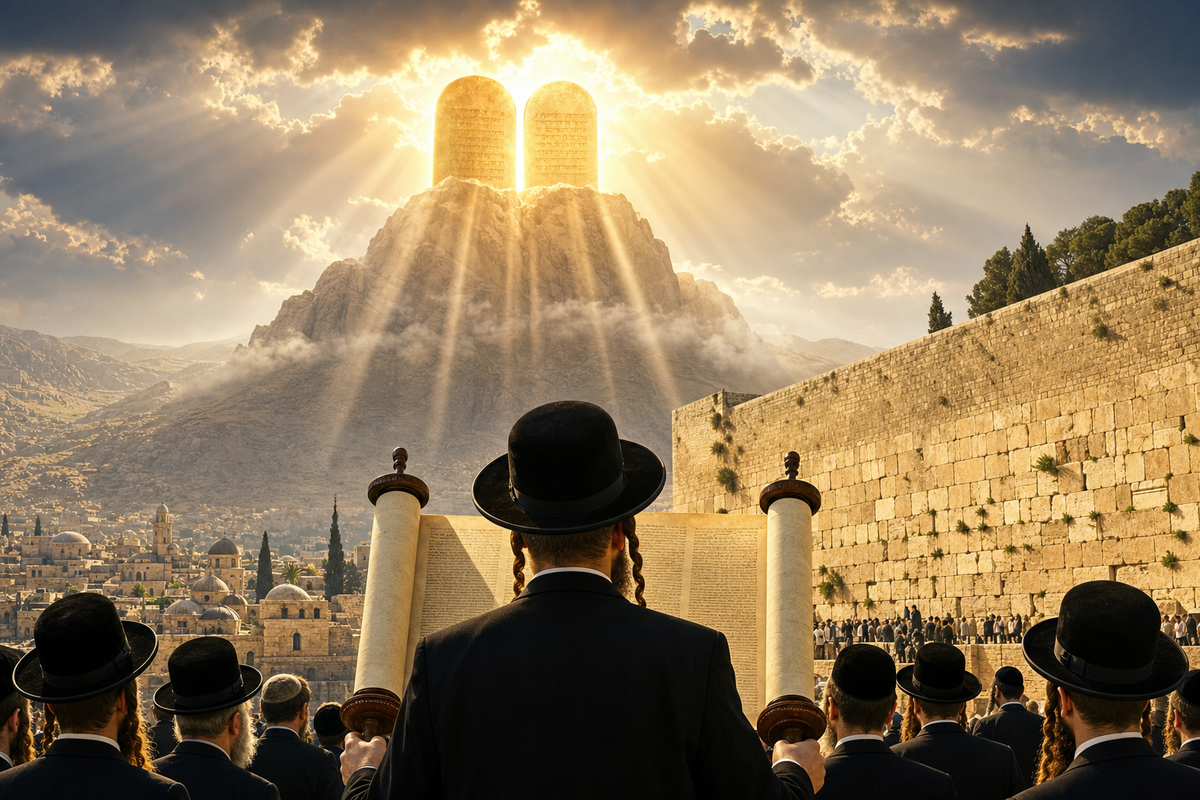
On the holiday of Shavuot, the day of Matan Torah (the Giving of the Torah), we are required to prepare ourselves to receive the immense illumination of the Ten Commandments. This lesson reveals how the primary path to merit this passes through the holiness of the home, a shining countenance, and the recognition that a wife is an aspect of the holy Shechinah (Divine Presence).
Our battle today, following the sin of the Tree of Knowledge where it says, "And the woman saw that the tree was good for food, and that it was a delight to the eyes," is over the blemish of the eyes. To the extent that a person fights for his holiness, so will he merit to hear the Ten Commandments. When he approaches Matan Torah, even right after the lighting of the holiday candles, he will begin to tremble from the awe of judgment and holiness.
Chazal (our Sages of blessed memory) say that regarding the Children of Israel at Matan Torah, it is stated:
"With every single utterance that emerged from the mouth of the Almighty, their souls departed" (Shabbat 88b).
For whom were these words written? Rabbi Avraham Ibn Ezra explains that this was said for us. Every word we hear must cause our soul to depart, to truly feel what Matan Torah is and what the Ten Commandments are. This is the greatest day of the year. Once a year we merit such a day, which is above all the holidays. It was impossible to give more than one day, because it is such concentrated power and such a mighty force.
How will we hear the Ten Commandments tomorrow? With what teshuvah (repentance) are we approaching the receiving of the Torah? True teshuvah begins with the holiness of the covenant and the eyes—"Do not draw near to a woman." A person must reach a state where, aside from his wife, he does not know any other woman in the world.
The Wife as a Chariot for the Shechinah
A wife is an aspect of the holy Shechinah (Divine Presence) in the world. Rebbe Nachman of Breslov explains that in the days of Avraham Avinu, the Shechinah was called by the name "Sarah." In every generation, there is a woman who sacrifices herself for Hashem, and she is an aspect of the Shechinah.
A clear example of this is Devorah the Prophetess. In Tanna D'vei Eliyahu (Chapter 9) it is stated:
"I call heaven and earth to bear witness... Hashem examines hearts and kidneys (innermost thoughts); He saw the heart of Devorah."
Hashem saw that all her 248 limbs and 365 sinews were entirely torches (lapidim) for Hashem. The word "lapid" (torch) in gematria (numerical value) is 124, and twice "lapid" (lapidim - torches) equals 248, corresponding to the 248 limbs. All 248 of her limbs were a holy fire for Hashem, 'a constant fire shall burn upon the altar; it shall not be extinguished.' There was no other fire within her besides the fire of love for Hashem. This holiness also characterized Sarah, Rivkah, Rachel, and Leah.
The Secret of the Dudaim and the Spiritual Attainments of Shavuot
The sefer "Bnei Yissaschar" explains that the episode of the dudaim (mandrakes) that Reuven found during the wheat harvest occurred exactly on the holiday of Shavuot. Seemingly, a question arises: Would two of the Matriarchs of the nation, Rachel and Leah, argue and fight over a few sweet berries or small apples?
Rather, the dudaim contained a tremendous secret of the revelation of the Cherubim and the Supernal Chariot. Leah Imeinu heard the Ten Commandments and merited to see supernal angels, the Ministers of the Inner Chamber. Rachel saw Leah's immense spiritual attainments and asked her: "Give me a taste of your attainments; I too want to taste from these revelations."
The argument over the dudaim was actually a tremendous spiritual yearning for the revelation of the Shechinah on the holiday of Shavuot. Out of that holiness, Yissaschar was born, about whom it is said, "men who had understanding of the times," and he became the pillar of Torah and the root of Torah within the Jewish people.
Transforming the Home into a Sanctuary for Matan Torah
As Rebbe Nachman taught, in the days of Avraham the Shechinah was called Sarah, in the days of Yitzchak it was called Rivkah, and in the days of Yaakov these were Rachel and Leah. From here we learn a tremendous foundation: Every person must work to ensure that his wife will be an aspect of the holy Shechinah.
When a person returns home, even if he has studied in the yeshiva for eight or ten consecutive hours, he must enter with a shining countenance. His role is to uplift the home and transform it into a vessel to receive Matan Torah, until the home itself becomes an aspect of the Mishkan (Tabernacle).
Only in such a holy and illuminated home can a person merit to hear the Ten Commandments right in his own living room. Since the wife is an aspect of the Shechinah, it is specifically through honoring one's wife and the holiness of the home that one merits to hear the voice of Hashem speaking the Ten Commandments.
The Secret of the Baal Shem Tov's Ascent to Heaven
When a person comes home with guarded eyes and holiness, after feeling the spiritual elevation of Torah study, and he is entirely a holy fire in preparation for receiving the Torah, he can elevate the home to incomprehensible levels.
The holy Baal Shem Tov once expressed himself and said: "If I had merited to live with my first wife, I would have ascended to heaven in a storm even more than Eliyahu HaNavi (Elijah the Prophet)." Eliyahu HaNavi ascended to heaven in the desert, across the Jordan River, with only his disciple Elisha seeing him. But the Baal Shem Tov said that if his first wife had been with him, he would have ascended to heaven in the middle of the day, in the heart of the marketplace of Mezhibozh, before the eyes of the entire congregation and assembly. Rebbe Nachman also testified similar things about himself.
Rebbe Nachman teaches that the wife is the aspect of prayer and she is the honor of the person – the "Honor of God." When a person does not pray with intention and blemishes the foundation of prayer, he blemishes this honor. The moment a person prays with intention and guards his holiness, he succeeds in elevating the aspect of honor and Malchus (Kingship), and transforms his home and his wife into a chariot for the holy Shechinah (Divine Presence).
Part 2 of 4 — Lesson No. 195
Subscribe to Our Newsletter
Receive Torah articles and inspiration directly in your inbox