The Secret of the Joy of a Chasan and Kallah: Building the Beis HaMikdash and the Illumination of the Shechinah
Lesson No. 148 | Motzaei Shabbos Kodesh Parshas Korach, Eve of 4 Tammuz 5758 - A class for the youth organization and Sheva Brachos (wedding blessings) at the Ido HaNavi Beis Midrash.
An in-depth article explaining the immense spiritual stature of a chasan (groom) and kallah (bride), who, through the power of their holiness and joy, can build the Beis HaMikdash (Holy Temple) and rectify the world. Through the profound teachings of the Megaleh Amukos, the Maharal, and Rabbi Nasan of Breslov, this piece explains how the chasan illuminates the kallah with the lights of the Shechinah (Divine Presence), and how joy has the power to bring about the complete Geulah (Redemption).
In order to merit bringing about the rebuilding of the Beis HaMikdash, we need holy and pure individuals who guard their eyes. Who knows, perhaps we will merit that even through just ten holy people who guard their eyes and remain deeply attached to the holy Gemara, the Beis HaMikdash will be rebuilt. We must engage in sincere soul-searching, lest we are the ones currently delaying the rebuilding of the Beis HaMikdash. We must mourn over the destruction of the Temple. In just two weeks, the Three Weeks—the days of Bein HaMetzarim (Between the Straits)—will begin, initiating our spiritual work of weeping. Every person must rise for Chatzos (midnight prayer), even if only for ten minutes, and truly contemplate and feel: "I am destroying the Beis HaMikdash."
However, the Gemara in Tractate Berachos states that today, the tikkun (rectification) is achieved through a chasan and kallah. This tikkun is accomplished by worthy, holy, and pure brides and grooms who desire only the absolute pinnacle of holiness and purity, refusing to compromise on even the smallest detail. As the Tzetel Katan (sections 1-3) teaches, a person must be prepared for mesirus nefesh (self-sacrifice) to sanctify Hashem's Name. Every chasan must take it upon himself that whenever he experiences physical pleasure, he will immediately reflect on his willingness to give up his life for the sanctification of Hashem's Name, thereby nullifying all physical desires. This is the very reason we came into this world—to battle and nullify every materialistic sensation.
The Chasan is in the Heavenly Realm of Shechakim
"Rav Huna said: Anyone who partakes of a wedding feast and does not bring joy to the chasan transgresses the five 'voices'... And if he does bring him joy, what is his reward? Rabbi Yehoshua ben Levi said: He merits the Torah, which was given with five voices" (Berachos 6b).
The joy of a chasan and kallah is literally a reenactment of the Giving of the Torah. We are granted seven days of receiving the Torah. The moment a chasan enters, all the sins of everyone present are forgiven. These are seven days during which all transgressions are pardoned, and there is a profound secret behind this.
The Megaleh Amukos (Ofan 99) reveals that the chasan is not actually present in this world at all. It may appear to us that he is here, but throughout the seven days of feasting, his soul resides in the heavenly firmament known as Shechakim. How do we know this? The numerical value (gematria) of the word chasan is 458, which is exactly the same numerical value as the word Shechakim. Just as the Heavenly Jerusalem is entirely beyond this physical world, the chasan is elevated to a completely different spiritual realm—the very firmament where the Torah was given.
He further explains that 458 camps, each consisting of tens of millions of angels, accompany the chasan throughout the seven days. The chasan himself is completely unaware of the lofty upper world he currently inhabits. In Parshas Vayishlach, the calculation of these angelic camps is brought down: "This is the camp of God... twenty million ministering angels." We are speaking of millions upon millions of angels escorting the groom. Every single camp represents a Divine revelation akin to what was experienced at Mount Sinai. Baruch Hashem (Thank God) that we merit having such an immense host of angels accompanying the chasan.
The Tablets of the Covenant: Right and Left
The chasan and kallah are the living embodiment of the Luchos (Tablets of the Covenant). The Midrash states that the chasan represents the right Tablet, while the kallah represents the left Tablet. One might mistakenly think: If the chasan is the right side, that is where the commandments between man and Hashem are engraved—"I am Hashem your God," "You shall have no other gods," and "You shall not take Hashem's Name in vain." Meanwhile, the kallah represents the left side, which contains the negative commandments between man and his fellow—"You shall not murder," "You shall not commit adultery," and "You shall not steal."
However, Rabbi Nasan of Breslov reveals a wondrous principle: The Tablets were engraved from both sides. When Moshe Rabbeinu held the Luchos, the side facing inward indeed had "I am Hashem your God" on the right and "You shall not murder" on the left. But because the letters were engraved entirely through the stone, anyone looking from the opposite side saw the exact reverse.
The kallah is more closely connected to the physical realm (the World of Asiyah). Therefore, her spiritual work begins with "You shall not murder"—which encompasses all the subtle details of refraining from lashon hara (evil speech) and not embarrassing others—and "You shall not steal," which includes avoiding any form of deception. Yet, on her inner, hidden side, "I am Hashem your God" is also inscribed. In contrast, the man is meant to be completely attached to Hashem and the holy Gemara twenty-four hours a day. Speaking lashon hara shouldn't even be a possibility for him; what business does he have gossiping about others? He is entirely removed from this mundane world. On the other hand, if he falls into a state of mochin d'katnus (constricted consciousness), he must remember that "You shall not murder" and "You shall not steal" are inscribed upon him as well.
Illuminating the Kallah with the Lights of the Shechinah
The Maharal of Prague explains why a Korban Todah (Thanksgiving Offering) is associated with every joyous occasion—a wedding, a bris, a Pidyon HaBen (redemption of the firstborn), and a housewarming. At a wedding, the Thanksgiving Offering expresses the elevation of the kallah to the exalted level of the holy Shechinah (Divine Presence).
Our holy Rebbe, Rebbe Nachman of Breslov, teaches in Likutey Moharan (Torah 17) that the entire role of the chasan is to illuminate the kallah with 224 supernal lights. The word V'ahavta (And you shall love) is mathematically equivalent to the word Ohr (Light) multiplied by two (Ohr is 207; 207 x 2 = 414, which is the exact gematria of V'ahavta). The chasan must constantly illuminate her with more and more spiritual light. The reason a person sometimes struggles to find his shidduch (marriage match) is because he does not yet know how to properly project these 224 lights.
The holy Patriarchs achieved this reality: Sarah Imeinu (our matriarch) embodied the Shechinah, Rivka was the Shechinah, and so too were Rachel and Leah. The sole purpose of the chasan is to elevate his kallah until she embodies the holy Shechinah. Through the immense joy associated with the Thanksgiving Offering, the chametz (leavened bread, symbolizing the evil inclination) is transformed into matzah (unleavened bread, symbolizing holiness).
A Woman Shall Encompass a Man: The Secret of the Jewish Home
The prophet Yirmiyahu prophesied regarding the days of Mashiach: "For Hashem has created a new reality on earth: a woman shall encompass a man." Our spiritual task right now, just before the coming of Mashiach, is for the feminine aspect to be elevated to the level of the masculine aspect. Indeed, today we see that women are studying and are highly knowledgeable in Halachah (Jewish law).
However, within this lies both a danger and a tremendous promise. If the husband truly goes to the Kollel, immerses himself in Torah study, and only returns home after the Maariv prayer—then his wife will naturally humble herself before him out of profound love and respect. She will joyfully run all day to assist and care for him. But if he neglects his Torah study, our Sages warn: "If you neglect the Torah, you will have many causes of neglect brought against you." If you waste even a single hour of Torah study, you will immediately find yourself scrubbing floors, washing dishes, and running errands to the grocery store.
Hashem, blessed be He, gave man a Garden of Eden—to study Torah. If he does not want this Garden of Eden and chooses Gehenna (hell), he becomes a slave to the matters of this world. The entire spiritual work is to elevate the woman to the level of man through tremendous joy and devotion to Torah, and then there is no hold for harsh judgments (dinim) in the home.
The Power of Joy to Build the Temple and Resurrect the Dead
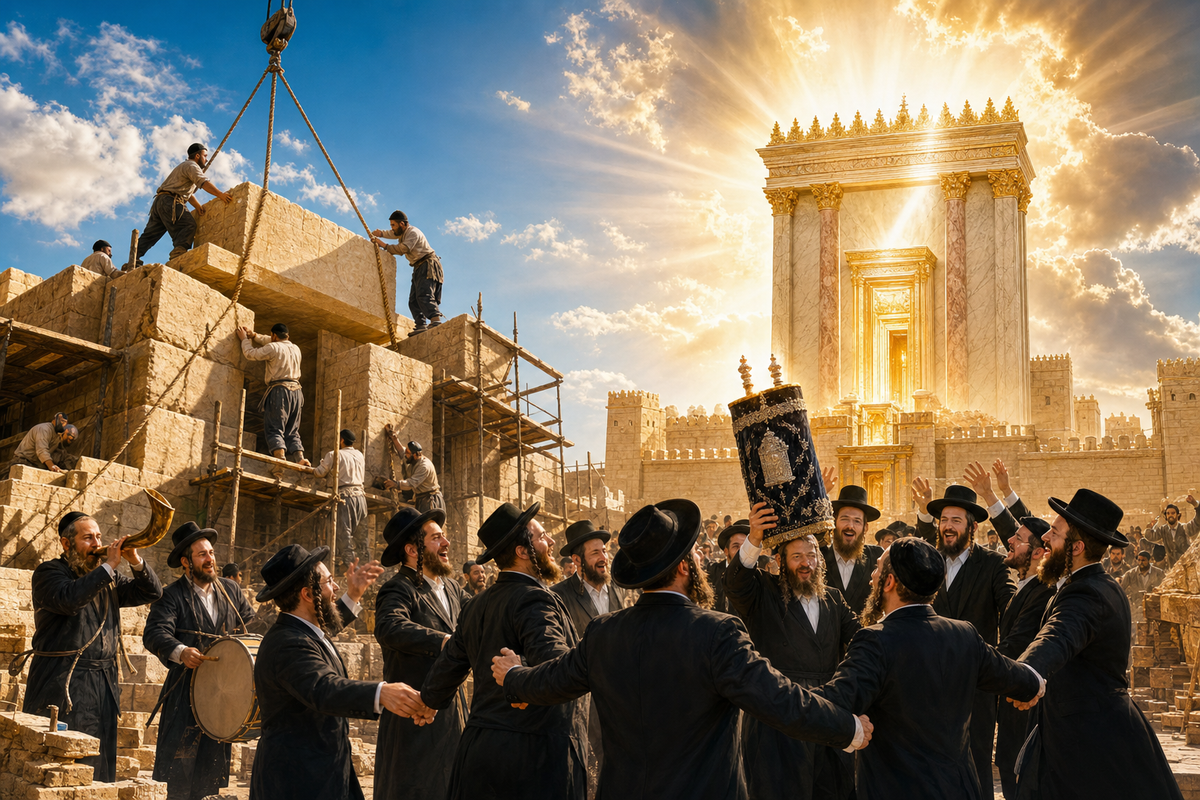
Through the joy of the groom and bride alone, it is possible to build the Holy Temple! There is no need to wait for the weeping of the Three Weeks (the mourning period for the Temple). We can act now, jump into all the joyous occasions, and be in a state of unceasing joy. If a person is in constant joy that does not cease for even a single second—the Holy Temple will be built.
The entire Geulah (Redemption) depends solely on joy. All the verses that speak about the Geulah are filled with joy: "The barren one will surely rejoice and be glad," "And as a groom rejoices over a bride, so will your God rejoice over you," "They will obtain gladness and joy, and sorrow and sighing will flee away." The joy that a groom experiences during the seven days of feasting is an aspect of rebirth. He needs to store this joy for his entire life, just like storing electricity in batteries. During this week, every day is equal to ten years of his life, and he completes the joy for all his seventy years.
Joy is the unity of Hashem, blessed be He. During a dance, people do not speak; they only dance and rejoice. During a time of joy, it is possible to nullify all harsh decrees and even reach the resurrection of the dead. The Gemara tells of Rabbah and Rabbi Zeira, who reached such a level of joy on Purim that Rabbah slaughtered Rabbi Zeira and then brought him back to life. This comes to teach us what tremendous power joy possesses. Therefore, it is customary at weddings to perform the "resurrection of the dead dance," because truly at a wedding, with all the joy, it is possible to resurrect the dead.
The Degel Machaneh Ephraim says: Anyone who comes and participates in the joy of a wedding is forgiven for all his sins, and no transgression remains in his hands. We only need to rejoice, dance, and believe that out of this joy, the Holy Temple will be built speedily in our days, Amen.
Lesson No. 148
Subscribe to Our Newsletter
Receive Torah articles and inspiration directly in your inbox