
The Secret of the Wise Woman: Eliezer's Test and the Upbringing of Children
Lesson No. 176 | Eve of Thursday, Parashas Toldos, 30 Cheshvan, First Day of Rosh Chodesh Kislev 5759
Eliezer, the servant of Avraham, was not merely looking for a young woman to give him water to drink. Rather, he administered a meticulous test of modesty, kindness, and wisdom to Rivka. Through this test, the immense role of the mother in educating children is revealed, and the correct path to imparting morals and discipline without violence is explained.
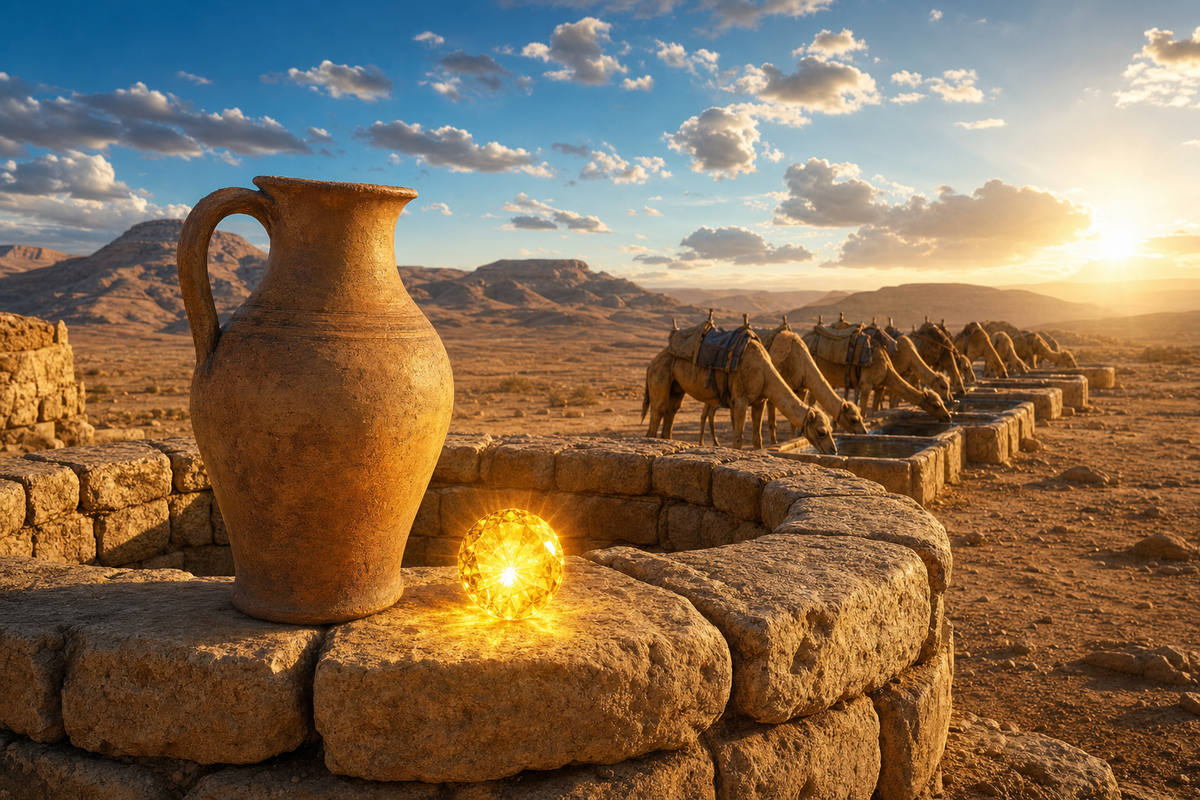
The Gemara in Tractate Bava Basra describes how, in the future, Hashem will spread the skin of the Leviathan upon the walls of Jerusalem, and it will shine from one end of the world to the other. Tractate Sofrim brings another secret related to the Hidden Light: Avraham Avinu built iron metropolises for the children of Keturah—giant cities covered in dirt and rocks, which today look like the mountains of Tibet and the Himalayas. The sun never entered there, but Avraham made for them a skylight of precious stones and pearls that shine brighter than the sun. These stones, called "Kadkod" (rubies), are destined to serve us in the future, as it is stated:
"And I will make your windows of rubies."
The Light of Sarah and Rivka
This tremendous light of the Kadkod stones was revealed in the holy Matriarchs. The Midrash Rabbah relates that when Avraham went down to Egypt and they opened the chest in which Sarah Imeinu was hiding, the entire land of Egypt shone from her radiance. Sarah literally illuminated like the sun, and as the Baal HaTurim hints regarding the verse, "And the life of Sarah was one hundred years"—the acronym of the words for her years of life forms the word Shemesh (sun).
That same light also appeared by Rivka Imeinu. The Torah repeats the word "kadah" (her pitcher) again and again ("and she lowered her pitcher," "and she emptied her pitcher"), to hint at the Kadkod stones. Suddenly, Rivka began to shine with a precious light, and the Name of Hashem began to hover over her.
Eliezer's Three Tests
When Eliezer, the servant of Avraham, goes to search for a wife for Yitzchak, he administers a meticulous test to her. Rebbe Nachman of Breslov explains in Likutey Moharan (Torah 2) that in order to know if a shidduch (marriage match) is a true match, in the aspect of "and from Hashem is a wise woman," one must test the woman in three areas: modesty, kindness, and wisdom.
The first test was the test of modesty. Eliezer says, "Please tip your pitcher so that I may drink." A modest young woman does not serve water directly in front of the face of a strange man; rather, she tips the pitcher from the side and steps back. Regarding Rivka, it is stated, "and no man had known her." The ancient Midrash "Me'or La'afelah" learns from here, as well as from the daughter of Yiftach about whom it is said, "and she knew no man," that she had never in her life looked at the form of a man. Eliezer wanted to see if she understood the hint of "Please tip your pitcher"—to serve the water modestly, from the side, without looking at him.
The second test was the test of kindness. Eliezer expected that she would offer water not only to him, but also to his camels, even though this involved ten thirsty camels returning from a long journey in the desert.
A Mother's Wisdom: Discerning the Child's Needs
However, the third and deepest test of all was the test of wisdom—whether she was a "wise woman." Eliezer said in his heart, "And she will say, 'Drink, and I will also water your camels,'" but Rivka answered with superior wisdom and said, "I will also draw water for your camels until they have finished drinking."
Rivka understood that a camel, the "ship of the desert," stores water in its hump for three days. She did not say "I will water them"—which implies giving them to drink immediately—but rather "I will draw"—I will draw a little water to see if they are even thirsty, since it is possible they drank not long ago. A wise woman knows how to discern what the child needs, whether he is truly thirsty or if he already drank at the neighbors'. This is the role of the mother—to feel and discern the nuances of her children's needs.
The Teaching of Your Mother: The Essence of Education
Why is it so important for the woman to be a "wise woman"? Because the essence of educating children rests upon the mother. In the book "Ben Poras Yosef" (by the author of the Toldos Yaakov Yosef), the verse is explained:
"Hear, my son, the discipline of your father, and do not forsake the teaching of your mother."
The "teaching" (Torah) is received from the mother. She is the one who is with the children, teaching them to wash their hands, to recite the Grace After Meals, telling them stories of tzaddikim, and making the mitzvos beloved to them. The father's role is only the "discipline" (mussar)—to back up the mother. When the father comes home, his job is to ensure that the children listened to their mother's voice.
And what is this "discipline"? King Solomon says in Proverbs, "He who spares his rod hates his son," and many mistakenly think the intention is to hit the child. However, a later verse in Proverbs explains the truth:
Subscribe to Our Newsletter
Receive Torah articles and inspiration directly in your inbox