
The Story of How Rav Odesser Drew Close to Breslov and to Rabbi Yisrael Karduner
The Daily Chizuk from Rabbi Eliezer Berland shlit"a
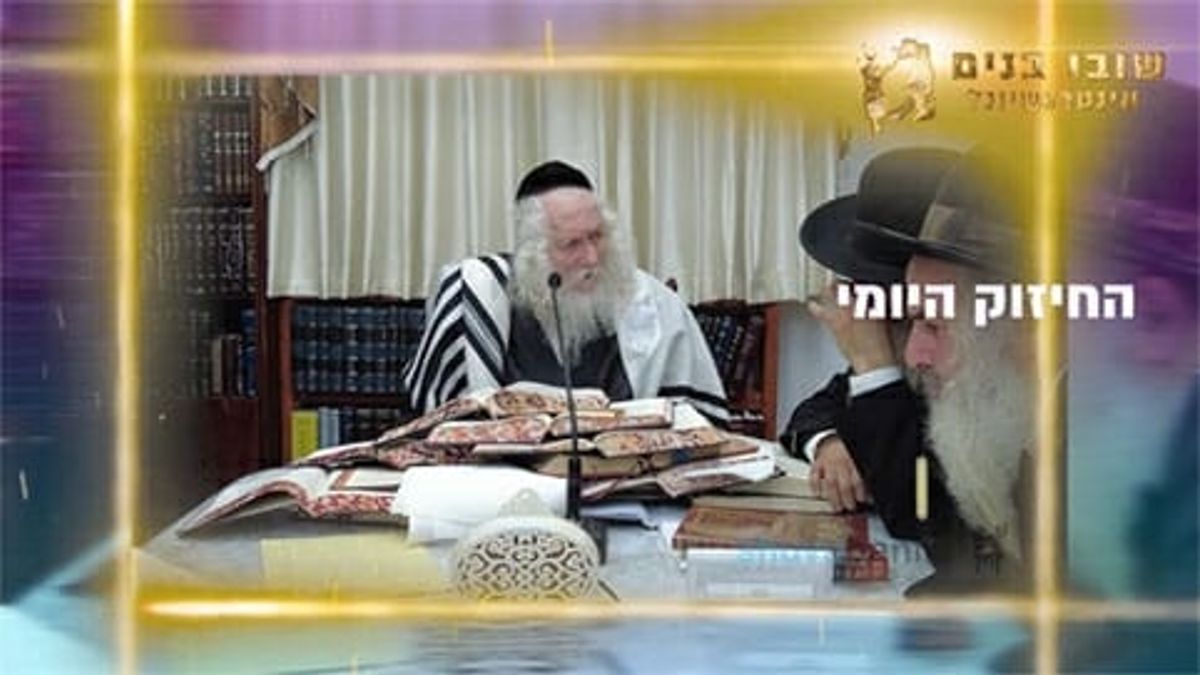
The full first-hand story—told as it has never been told—of how the holy grandfather drew close to Rabbi Yisrael Karduner and to Breslov Chassidus
Tuesday, 15 Iyar 5785 — Mesirus Nefesh to draw close to holiness in a time when Breslov Chassidus was not known and was viewed as something negative
These are his holy words:
Zalman Shazar (the third president of Israel) was Breslov. He became a true Breslov chassid. He would correspond with Rabbi Yisrael Dov Ber Odesser. At the time, he was an inspector in the Ministry of Education, or the deputy minister of education, and he came to Tiberias to see whether they were learning—every so often they would come to conduct an inspection.
Zalman Shazar saw that everyone was learning Gemara, and only Rabbi Odesser was saying Likutey Tefillos. He wasn’t learning Gemara—he was only saying Likutey Tefillos every day.
Rabbi Shalom Alshich (Alfandari) passed away in Adar at the age of 115. He was the Rav of Tiberias, and afterward the Rav of Jerusalem. He said: “Pay Rabbi Odesser immediately!”
They told him: “But he only says Likutey Tefillos…”
He answered: “He is the one holding up your yeshivah! His Likutey Tefillos is what sustains the yeshivah. For him, the yeshivah is Likutey Tefillos. He needs to say Likutey Tefillos all day and not stop for even a minute—he says Likutey Tefillos, Likutey Tefillos all day.”
He said: “This is what I know—to say Likutey Tefillos, Likutey Halachos.” That is what he said his entire life.
Rabbi Odesser stayed by us at home—he slept in our house for a year. He would travel to us for Shabbos. You (R’ Nachman Berland) were still a child—you were born in 5685, and then he came to us. He stayed with me a full year because he wanted money for his grandson, Rabbi Amram Horowitz—the son of his daughter (the chassidic Rav, R’ Amram Yosef HaLevi Horowitz b”r Moshe Nachum zt”l, director of ‘Keren Rabbi Yisrael Dov Odesser’).
https://vimeo.com/1083725869?share=copy
He passed away at the age of 105. In the year 5674 he was 17, and that was when he saw Rabbi Yisrael Karduner arrive (Rabbi Yisrael Heilprin, known as Rabbi Yisrael Karduner, after his city of Kardan; approx. 5627/1867 – 9 Cheshvan 5679/1918. He was one of the prominent rabbis of the fourth generation of Breslov Chassidus and published several of its sefarim. He is known as the Rav of Rabbi Yisrael Dov Odesser). And he said to them: “Is it possible to eat here?”
Rabbi Yisrael Karduner was riding on a donkey. In those days there were donkeys—today there aren’t donkeys anymore. It was a good time, a pleasant time. I used to ride on a donkey from Meron to Tiberias. You see the sky, you see the rain, you breathe. In a Mercedes you suffocate—you can’t travel in a Mercedes. I suffocate in a Mercedes. I won’t travel in a Mercedes anymore. But on a donkey I’m willing to go—I don’t care. You can breathe.
Rabbi Yisrael Karduner got rheumatism (an inflammation that attacks the joint lining). He could no longer move his hands. Back then there was no heating like today—today in Meron there is heating. There was no heating; everything was open and exposed. We’re speaking about the year 5674, 110 years ago. Rabbi Karduner was there in Meron in the month of Teves, in terrifying cold. Snow was falling, and he literally froze.
Rabbi Karduner nearly froze to death—he was in mortal danger. So he opened Likutey Halachos, Yoreh De’ah, and it came out there that he needed to travel to Tiberias.
Rabbi Karduner said: “What—should I leave Meron? Chas v’shalom, I’m not leaving Meron! The first thing is to be in Meron.”
That is the mitzvah—to go to a mitzvah on foot. You should always go on foot. Rabbi Karduner would finish Maseches Beitzah on the way. He would walk from Tzfas to Meron—two hours on foot. When I ran it in 20 minutes—we ran it then, at age 19 and a half. We ran from Tzfas, from Har Kena’an, to Meron. In 20 minutes we managed to get there. He walked it in two hours—and in those two hours he finished the entire Maseches Beitzah, going and returning, twice.
That’s how he was—he would remain a day or two in Meron. Karduner did three days of Hisbodedus, and then he opened Yoreh De’ah to ask whether to leave Meron—because how can you leave Meron? He said: “I want to be with Rabbi Shimon!”
He told me: “How is it possible? How I got to Jerusalem, I don’t know. Next time I’ll come to Meron, to you.”
(Rabbi Berland shlit"a says): You don’t leave Rabbi Shimon! There is no such thing! Under no circumstances—no!!!
(There is another possibility:) Either Rabbi Shimon will come here. If I came here, then I came with Rabbi Shimon! Apparently Rabbi Shimon is here now as well!
Just as the Rebbe said: “Rabbi Shimon is with me and everyone is dancing”—wherever the Tzaddik is, that is where Rabbi Shimon is.
Rabbi Yisrael Karduner rode on the donkey as rain poured down. It was Teves—like a flood. There was a cloudburst; all the streets were flooded with water. He met Binyamin Farber, who was the brother of Rabbi Yisrael Ber’s mother—of the holy grandfather. He asked him: “Can I get some bread here from someone?”
Binyamin Farber said: “Yes—right now my sister needs to buy bread.” It was on Thursday. On Sunday, Binyamin Farber went to the flour station in Tiberias and borrowed flour. He told the flour seller: “I’ll pay you. I’m responsible. I’m the guarantor.”
It was a miracle that Karduner met Binyamin Farber in the darkness, in the middle of the flood, while torrential rain was falling. He told him: “Go to the end of the street and you’ll see a house that’s half in the ground—a little hut like that. Knock on the door. I don’t know if they’ll answer you—it’s already 9 at night; they probably went to sleep.” It was already dark and there was no electricity—not like today, even up to Meron. The candles had gone out.
He went to the end of the street and saw a house sunken into the ground, ready to collapse. He went to the hut and knocked. Yisrael Ber opened—the holy grandfather was a 17-year-old boy. He told me: “I saw a spotlight. I saw the sun.” He said: “I saw the sun—suddenly it became light like a spotlight.”
Rabbi Yisrael Odesser said: “I prayed about Breslov,” because he didn’t know what Breslov was. In those days people didn’t know what Breslov was. They knew about Karlin and Slonim—that’s what they knew. In Tiberias there was Karlin and Slonim. They didn’t know at all that Breslov existed in the world. It all began when Rabbi Odesser suddenly found the sefer Meshivas Nefesh (by Rabbi Nachman of Tcherin) in the garbage. He was 17 and he had no chavrusos. He had a blind father and he couldn’t manage to advance. He was broken, and suddenly, with Meshivas Nefesh, he began to live.
He would read Meshivas Nefesh every day at noon, during the break between 1 and 3. Suddenly a young man of 20 approached him—he was 17. The young man asked: “What are you reading?”
The holy grandfather didn’t even know the name of the sefer, because the first pages were missing. The young man shouted at him: “That’s Breslov! You don’t know what Breslov is?”
Rabbi Odesser asked: “What is Breslov—what does it mean?”
The young man said: “All the great ones of the generation came together with Eliyahu HaNavi and made a ban against Breslov. They are apikorsim, they are apostates. You’re forbidden to endanger yourself with it.” That’s how it was—this is a true story.
Rabbi Odesser grabbed him and answered: “If Eliyahu HaNavi comes now and tells me it’s forbidden to read this sefer, I’ll tell him: No—you are not Eliyahu HaNavi. That can’t be. That is not Eliyahu HaNavi.”
The young man tore his sefer. He was left with two pages. He gave him two slaps. Rabbi Odesser was 17—this was the first time he heard that there is such a thing as Breslov. People didn’t know what Breslov was—maybe it was angels. He began to pray to Hashem that He should send him Breslov: “Send me Breslov. I’m here in Tiberias alone, in the rain.”
A blind father, a sick mother—nine souls in the house, sleeping in a room as small as a kitchen, on the floor. Rabbi Odesser cried out: “Hashem, send me Breslov!” He learned out in the field by Rabbi Meir Baal HaNes. Every night he cried for two hours: “Send me Breslov.”
Suddenly he saw Karduner and said: “I asked for Breslov—they sent me Eliyahu HaNavi!” He saw an angel. He saw a face like a spotlight—literally.
Rabbi Karduner asked: “Can I get a slice of bread here?”
The Odesser family answered: “Yes—exactly, we have one last loaf left.” They had just begun baking bread. They received flour on Sunday; now it was already Thursday—one loaf remained. He washed his hands—such washing of the hands the holy grandfather had never seen in his life, such deveikus. “HaMotzi lechem min ha’aretz,” and afterward Birchas HaMazon—an entire hour of Birchas HaMazon.
In the end he ate two slices and drank a cup of tea. Rabbi Odesser wanted to make him an omelet—something. Rabbi Karduner said: “Under no circumstances. I only want to drink a cup of tea—that is my food.” He stood to leave. The holy grandfather escorted him, and the rain was pouring—torrential rain—and he stood under the doorframe.
Rabbi Yisrael Dov told him: “Listen—I prayed for a Breslov chassid. You must be Eliyahu HaNavi.” Then Rabbi Karduner understood who this boy was—someone who had been begging in prayer for two months that they should send him a Breslov chassid, someone searching for the truth, entirely prayer.
Rabbi Karduner asked him: “So—good. Is there an open shul here, somewhere we can learn?”
They went to all the shuls and they were all locked with a bolt, because it was raining and they didn’t want the Sifrei Torah to be stolen. So they went to the seashore and found the shul of Rabbi Menachem Mendel of Vitebsk (the synagogue of the earliest Chassidim in Tiberias, also known as the Karlin-Stolin synagogue in Tiberias. It is a synagogue building constructed in 1786 in the center of the “Courtyard of the Jews” in the Old City of Tiberias, near the shore of the Kinneret. It was first built in 1786 by Rabbi Menachem Mendel of Vitebsk and Rabbi Avraham of Kalisk, who led the Chassidic aliyah).
It is there until today (in the earthquake in the Galilee in 1837 the synagogue was destroyed, and it was rebuilt by the Karlin chassidim at the instruction of their Rebbe, Rabbi Aharon (the second) of Karlin. When the Jewish quarter was demolished, the chassidim protected it so it would not be harmed, and in this way the other ancient synagogues in the “Courtyard of the Jews” also survived). It is ממש right by the shore, but there was a lot of water there.
They found the key to the shul, opened the door, and climbed onto the bench—the water reached up to the bench. They climbed onto the bench and sat on the table. He lit a candle. There were no matches—it was during World War I. No matches, no candles, no food—nothing.
Suddenly he lit a candle and they began learning “Ki Merachamam Yenahageim” (Likutey Moharan II, Torah 7), from 9 at night until 5 in the morning—seven hours learning “Ki Merachamam Yenahageim.” Suddenly he heard his mother screaming, “Yisrael! Yisrael!” He said: “My mother is screaming—my mother went to look for me. She reached the seashore. She went through all of Tiberias asking, ‘Where is Yisrael?’ The boy disappeared from her. ‘They already kidnapped him from me! A man came and stole my child. They gave him food, they gave him a piece of bread and a cup of tea, and in the end he disappeared with my child. He kidnapped my child—a kidnapper, a thief of souls!’”
Fine. Rabbi Odesser ran to his mother: “Mom, I’m here!” She found him in the shul of the Vitebsker. In the morning the whole city came, because she had gone through the whole city crying, “Yisrael, Yisrael…” From then on, the holy grandfather remained bound to Rabbi Yisrael Karduner.
From the year 5674, he couldn’t walk in the street without people throwing rotten tomatoes at him—because Breslov was viewed then as worse than apikorsus, worse than apostasy. They threw rotten tomatoes, eggs—everything they threw at them.
His father-in-law was such a hater of Breslov. They told him: “He (your son-in-law) became Breslov,” because Rabbi Odesser was already engaged. If he hadn’t been engaged, he would never have married (as a Breslover).
The father-in-law said: “Don’t worry—I’ll get him out of it in a second. It’s madness, it’s insanity—he’s gone crazy on me. True, he’s my son-in-law, a good young man, and I’m not giving him up. But he’ll only be my son-in-law, and in one second I’ll pull him out of this madness.”
Then the Odesser family made a caravan to Tzfas. The father-in-law said: “First thing, I’m moving to live in Tzfas. First thing is to live in Tzfas—before everything.” They went with Rabbi Yisrael Odesser and the whole family—the uncles—in a caravan of donkeys, with torrential rain pouring down. Everyone was now going to Tzfas to flee from Rabbi Yisrael Karduner, and suddenly they saw down in the wadi Rabbi Karduner with the donkey—his wife and his four children.
Rabbi Karduner rented an apartment near him. Then there was a wedding, and during the Sheva Berachos Rabbi Odesser decided he wanted to see Rabbi Yisrael Karduner. On Erev Shabbos Kodesh he wanted to run to him. The problem was that he lived together with his father-in-law in the same courtyard. There was no door between them, and the father-in-law placed him in the inner courtyard so that if he tried to escape, he would hear that he ran away. So Rabbi Odesser crawled under the window on all fours, on the courtyard floor. He opened the door and it broke into pieces.
His father-in-law woke up: “What—he’s escaping from me? He’s running to Rabbi Yisrael Karduner?” The door was open, so he immediately ran after him. For about 5 or 10 minutes he ran. Rabbi Odesser ran faster—how he had the strength to run, he didn’t know. He reached Rabbi Yisrael and told him: “Here, I made it. My father-in-law is chasing me!” Rabbi Yisrael Karduner sent him back home.
Then the father-in-law saw that it was already impossible to take him out of this “madness” (drawing close to Breslov). So he told his daughter to get divorced. She told him: “I’m not getting divorced. I’ve never seen such a good young man in my life,” because Rabbi Odesser would pamper her.
The main thing is that a man should know how to pamper his wife—every day to buy her chocolate, every day to buy her.
Subscribe to Our Newsletter
Receive Torah articles and inspiration directly in your inbox